Built inside the CAP code, GDPR and your professional works

Your clinical standards were never the reason your enquiries are inconsistent

Practice growth systems for UK ADHD and autism diagnostic clinics, specialist therapy groups and corporate wellbeing providers. Built inside the CAP Code, your professional frameworks and UK GDPR.

No obligation, no pitch deck, and nothing sold to you on the first call.

There is a number in your practice that almost nobody has calculated. 
Once you know it, the way you make marketing decisions changes permanently.

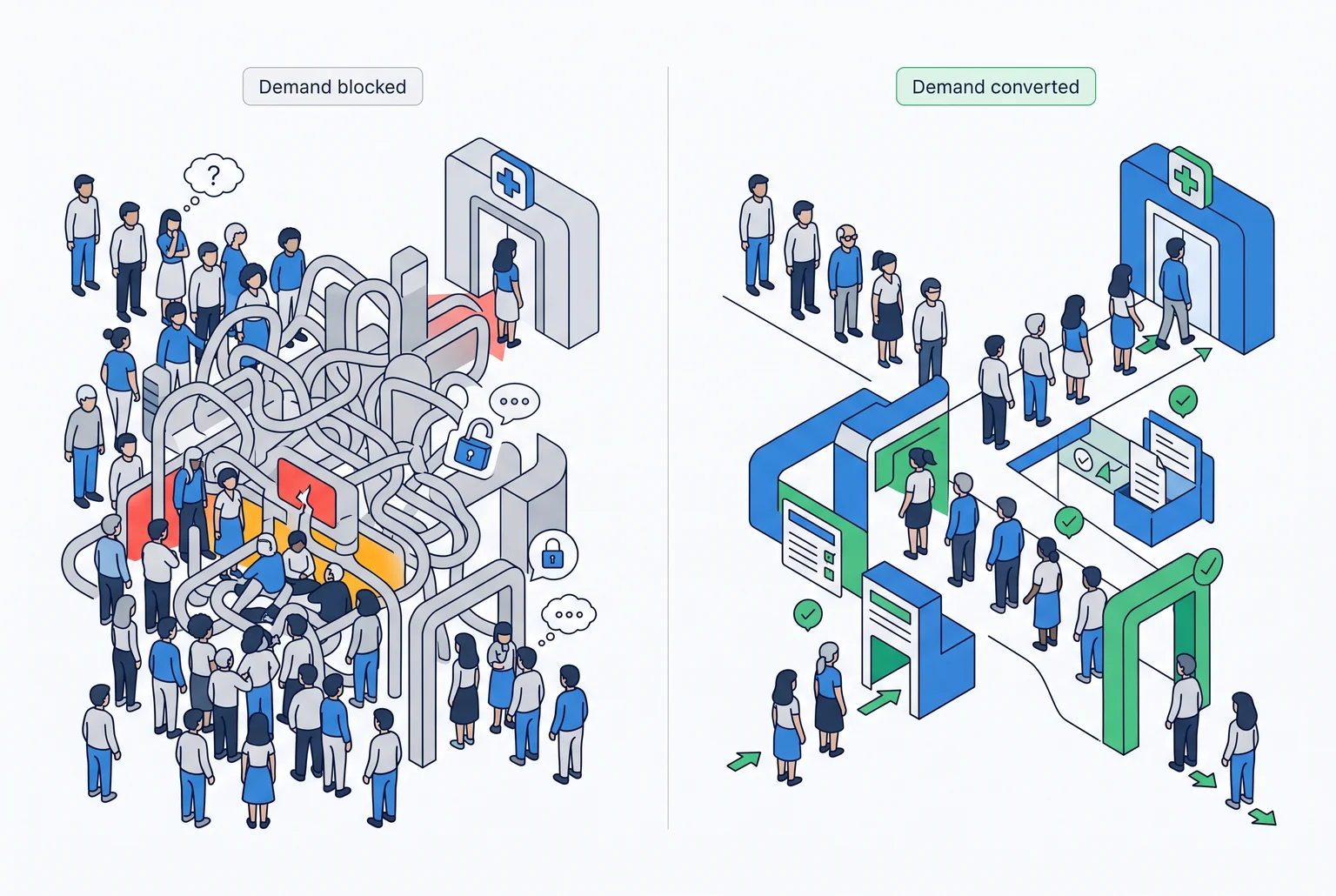
Consider this. A mother writes to you late on a Tuesday about her fourteen-year-old. Two years of letters home from school, and a health service that has offered her a place in a queue several years long. Your administrator replies the next morning — courteous, thorough, fee schedule attached. You never hear from her again, and by Friday you have forgotten she wrote.

Now, what did that actually cost you?

Ask most practice owners that question and they reach for the assessment fee, because the invoice is the only part of the answer anyone has ever shown them. A private adult ADHD assessment sits at around £800. So the loss gets filed, quietly, at eight hundred pounds. A pity. Not a crisis. The diary is busy enough as it is, and on we go.

And it is wrong by a margin wide enough to change how you spend money.

But the assessment was never the transaction. It was the door. Titration follows, then medication review, then the annual appointment, then years of shared-care correspondence — and frequently a sibling assessed eighteen months later, because by then the family trusts you. In a therapy practice the same principle lands harder still. At £100 to £180 an hour, trauma or eating disorder work is not six sessions. It is a commitment measured in seasons.

The fact is, the figure you ought to be holding in your head is what one enquiry is worth across its whole life with you, not what it bills in month one. I have sat with clinical directors while they worked that out on the back of an envelope. They tend to go quiet for a few seconds.

And here is the part that should trouble you rather more.
How many enquiries did you lose last month?

Chances are you do not know. Almost nobody in this sector does, and in my view that is precisely why the problem never gets fixed. A patient who goes elsewhere does not complain. A GP who quietly stops referring does not write to tell you why. The losses are silent, so they never reach an agenda — they turn up two quarters later as a thin diary nobody can account for.

Think back to how you qualified. The supervised hours, the ethical framework you could recite in your sleep, the registration you worked years for. At no point did anybody sit you down and teach you how to be found by a stranger who needs you.

I would be astonished if that were not true of you. For a long time it did not matter much. It matters now, for three reasons that arrived close together.

 The room got crowded

BACP membership stood at roughly 35,000 in 2010 and is near 75,000 today — the workforce has doubled inside a decade. Your standing has not fallen; the number of people your prospective client is choosing between has risen sharply. There is a second difficulty sitting on top of the first. In this country the titles counsellor and psychotherapist are not protected in law. Anyone may use them. There is no register they are obliged to join and no qualification they are obliged to hold.

Consider what that does to the person choosing you. They have two profiles open on a phone. One belongs to a clinician with a doctorate, HCPC registration and twenty years of supervised practice. The other belongs to somebody who completed a course over a weekend. Both pages say therapist. Both look perfectly professional. Nothing on that screen tells them which is which, and they have about thirty seconds of patience before they pick one.

Your credentials are real. They are simply not visible at the moment the decision gets made.

Your buyer lost their bearings

Then, in March 2026, the CQC confirmed that diagnosis-only providers no longer require registration — so a signal families had relied on to tell a governed clinic from an opportunistic one disappeared from view. A frightened parent, an overloaded GP and a Head of Reward now share one predicament. None can assess clinical quality, so all three judge on what they can see.

The shortlist moved somewhere you cannot watch it being made

Your buyer increasingly asks an assistant rather than a search engine, and gets back three names. If yours is not among them you were never in the running, and no advertising recovers the position — because the search you hoped to win was never run.

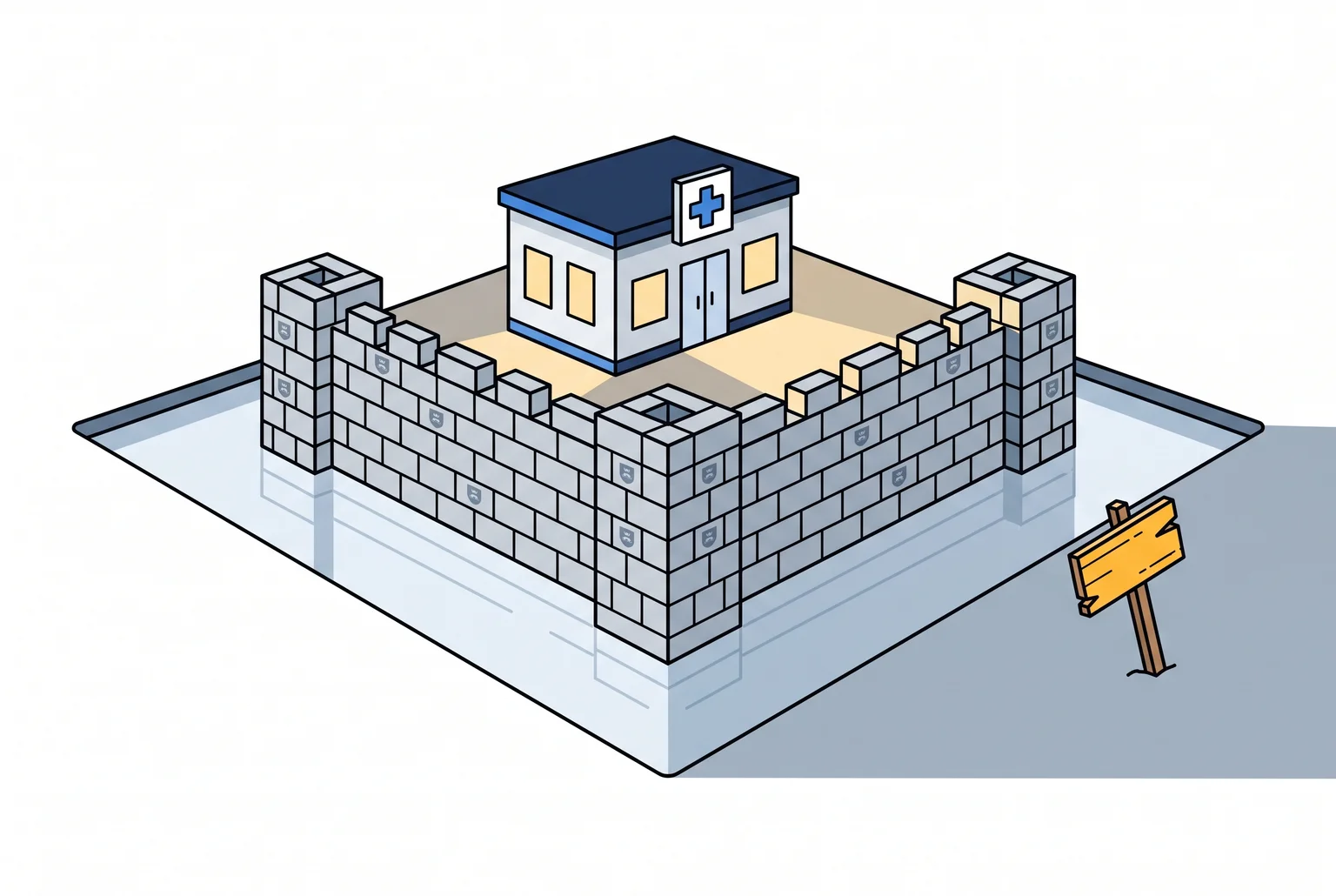
Three changes, one consequence. The rigour that makes you the safer choice is the part your buyer cannot see.

That is a solvable problem. It is not solved by spending more.

Choose your track

Three markets. One protocol.
Three very different applications.

ADHD and autism diagnostic clinics and private psychiatry

The private share of ADHD medicine supply climbed from around 8% in early 2023 to roughly 14.5% by mid-2025, and recorded ADHD among women aged 31 to 49 rose several hundred per cent in five years. You are doing work the health service cannot currently reach. Waits run to years, families cannot wait that long, and you are the reason a great many of them are assessed at all. Yet much of the national coverage has cast the independent sector as the problem rather than the response to it — profiteering, diagnosis mills, a market in need of reining in. You will have read those pieces. So have your referring GPs.

So attention is not what you are short of. Demand arrives whether you market or not.

What you are short of is any way of being told apart. Until March 2026, CQC registration did that job for you — a parent could check a register and draw a conclusion from it. Diagnosis-only providers no longer require registration, so that signal has gone. Which leaves a frightened parent at ten at night holding four clinics that look broadly identical on a phone screen, and no reliable means of telling a governed service from an opportunistic one.

Group and multidisciplinary therapy practices

Group and multidisciplinary therapy practices. Trauma and EMDR work, eating disorders, perinatal, specialist psychology teams. Consider what one full associate diary is worth. A clinical psychologist charging £120 an hour and seeing twenty clients a week brings in something in the order of £128,000 across a working year. Now halve it. An associate running at half capacity is not a minor inefficiency to be tidied up next quarter. It is a five-figure hole, and it will comfortably exceed any marketing budget you have been hesitating over for the past twelve months.

The fact is, that hole is rarely caused by a shortage of demand for the modality. It is caused by enquiries arriving and not being matched, answered or held.

And the help available to you is thin. Agencies serving individual therapists have multiplied over the last decade, and their playbook is built for a sole practitioner with one diary and one specialism. Very few have ever looked closely at a practice running eight clinicians across four modalities, where one intake process has to route a trauma referral, a perinatal referral and an eating disorder referral to the right person first time. That routing is the whole game. It is also invisible to anybody who has never had to build it.

Corporate wellbeing and
EAP  Providers

Your commercial difficulty begins with something you cannot fix by improving the service. An employee assistance programme is confidential by design. The employee who used it at two in the morning does not tell their line manager, and quite rightly. So the buyer who signed your contract never once sees the thing working. What they see is an invoice, a utilisation figure and a renewal date.

The economic case for the work is strong. Deloitte's employer research puts the annual cost of poor mental health to UK business at roughly £51 billion, and finds a return of roughly £4.70 on each £1 an employer puts into workforce mental health.

And you still lose renewals to a competitor whose price per employee undercuts yours by pennies.

Why? Because the argument that would have saved the contract needed making in rooms you were not in. Around 95% of buyers in a market like yours are out of market at any given moment, thinking about none of this. Then something moves — the renewal window opens, a new People Director arrives, the board asks a question about absence — and they turn to the provider whose name they already trust. By the time anybody tells you a decision is being made, it has largely been made.

Three markets, one method, three very different applications.

Who is talking to you?

I am George Ogunsiji.
I run The Practice Growth Partnership from Sussex, I work with practices across the United Kingdom, and I should say plainly that I am not a clinician.

I came to this from facilities management and engineering, where a system either functions or it does not, and nobody is remotely interested in your intentions once it fails. What I watched for two decades was capable operators losing steadily to weaker ones. Rarely on skill. Almost always on being harder to find and slower to answer.

Then it became personal. My partner is an experienced therapist, and when she set up in Hove her clinical ability was never the question. Her diary was. Over eighteen months we stopped treating her visibility as a run of separate tactics and built it as one system. 

The quiet weeks stopped, and nothing whatsoever changed about how she practised. Now, two things you would get around to asking me eventually, and you would be quite right to ask them. So I will put them on the table myself.

The first is that she is my partner. That was not an arm's-length commercial engagement. I had every reason in the world to want it to work, and I have never presented it as anything other than what it was.

The second is that you will find no percentages attached to it anywhere on this site, and that is deliberate. One practice proves nothing on its own. The figures are hers to publish rather than mine. And in my view you should be wary of any adviser who waves a single number at you as though it settles the question — because the number you are shown is always the best one they have, and you are never shown the engagements that went nowhere.


What those eighteen months did produce was a method. I then took it apart stage by stage and tested it against the advertising rules and the ethical frameworks governing regulated practice, to be certain that none of it would put a clinician in a difficult position. Then I wrote it up properly. That document is further down this page, and it is yours.

What we actually build

Reputation systems.
Your professional body may restrict or forbid testimonials outright, and most agencies treat that as the end of the conversation. It is not. We build a review engine that fits the constraint: clinical feedback kept separate from public review requests, consent captured at intake and treated as a marketing communication under PECR, replies that never confirm anyone was a patient, no incentives at any point. Where your framework prohibits testimonials altogether, we build the aggregate alternative instead. By that I mean a substantiated statement about the service as a whole, drawn from feedback you already collect, which identifies nobody at all. Something along the lines of: of the last two hundred families we assessed, the average rating given for clarity of the written report was 4.7 out of 5.

Consider what that sentence does. It breaches no confidence. It names no individual. And it is a claim you can evidence from your own records the moment anybody asks. In my experience it also lands harder with a cautious reader than any single quotation, because one glowing testimonial can be cherry-picked and your reader knows it.

There is a second return on the same work. Review volume and how recently reviews were left are among the factors deciding who occupies the top three local search results. So a properly run review engine improves your standing with the person reading and your position in the listing that brought them there. One piece of work, paid for twice.

Content marketing and distribution.
Named clinicians writing about process and evidence, sourced to NICE, the NHS and the regulators, reviewed and dated. Process, never outcomes. We then place it beyond your own website — news, blog, podcast and video platforms — so your people are quoted where a referrer might come across them. Why does that matter? Because a GP forms a view of you long before any referral arrives, usually without ever visiting your site.

Local SEO and Google Business Profile.
Profiles built and maintained for every location, specialism-and-place pages, consistent naming across every directory and register you appear on. Proximity, review volume and recency largely decide the top three local positions, and those three collect most of the clicks. National telehealth and business-to-business providers get the region-targeted equivalent.

Missed call text back, and AI voice where it suits you.
A call goes unanswered because every clinician is in session. The caller gets an immediate text acknowledging it and giving a window for a reply. This is usually the fastest money in the building, for an obvious reason — the call nobody logged is the loss you cannot investigate. Out of hours, a voice agent can take a name, a number and a reason for calling. For an out-of-hours line where callers are mostly making practical enquiries — fees, waiting times, whether you assess adults — that is a considerable improvement on a phone ringing into an empty room.

For a service whose callers may be in acute distress, it is plainly the wrong tool.

So the decision belongs to your clinical lead rather than to us. Where we are asked, our default is deliberately narrow: out of hours only, taking a name, a number and a reason for calling, with a route to emergency services stated at the front of every call. And when we think the honest answer for your service is no, you will hear that from us rather than a proposal.

Email and SMS follow-up.
We set the system up and help you write it: the sequence for someone who has gone quiet, the material for a person not yet ready, the rhythm of contact with referrers who need to hear from you between referrals rather than only during one. Consent captured properly, an opt-out in everything, nothing sent to anybody who did not ask. Committing to pay privately is rarely an afternoon's decision, and most practices reply once and then bet on being remembered.

Two cautions, and they matter more in your sector than in any other

The acknowledgement tells the enquirer the window in which a person will respond — the same working day, or before noon tomorrow. It does not name a time, because meeting that time is your side of the arrangement rather than ours, and a promise you cannot keep is worse than no promise at all. We will help you set a window you can actually hold.

And an automated acknowledgement written in commercial language will do more harm than silence. We write it to sound like your clinicians, we put no promise in it that you cannot keep, we make no claim about outcomes, and we route anyone in crisis to emergency services. Your clinical lead signs it off before it goes anywhere near a patient.

The Practice I.M.P.A.C.T. Protocol

Six systems decide whether a practice grows predictably or lurches between famine and overload

I

Integrity of Delivery

How consistently does every patient, client or referrer receive the experience that you promise?

M

Measured Authority

what are you doing to protect the practice's standing?

P

Professional Availability

How quickly does a serious enquiry receive a serious reply?

A

Accelerated Value

What value is left unrealised inside the care you already provide?

C

Cultivated Relationships

How do you hold the attention of people or referrers who are not currently ready to decide?

T

Targeted Growth

How do more of the right people know that you exist?

The order carries more weight than any single stage, and almost everybody gets it wrong in the same direction. They start at T. Why? Because T is the only part that resembles advertising, and the only part you can buy on any given day when the diary looks worrying.

So the web visitor traffic arrives, and it arrives at a practice with nothing built to handle it.  Nobody answers the enquiry inside the limited opportunity window before the propect decides to go elsewhere. There is nothing on the page that persuades a cautious reader you are the safer choice. There is no means of holding the person who is interested but not yet ready to make a financial commitment, and no route back for them in three months when they are ready.

The marketing money goes out but there is no revenue coming back. And the owner draws the only conclusion available to them, which is that this sort of thing does not work for practices like theirs.

That is not a verdict on marketing. It is a verdict on the running order.

Which brings me to what we take on and what we do not. We build the systems supporting five of the six stages — Measured Authority, Professional Availability, Accelerated Value, Cultivated Relationships and Targeted Growth.

Integrity of Delivery stays with you, because it is clinical and operational, and no marketing consultancy has any business inside your intake, your reporting or your handovers.

What we will do is tell you plainly if that is where the difficulty actually sits. If assessment reports are going out three weeks late, more visibility will only carry that further, and I would far rather say so before taking your money than afterwards.

Named, not merely found

Being cited by an AI assistant is not a variation on ranking. Nothing is ranked — something is quoted. That rewards a different set of qualities: questions answered directly rather than positioned around, clinicians named with verifiable credentials, sources a model has reason to trust, structure it can read, and the same description of you appearing consistently across registers, directories and third-party coverage.

Two consequences follow, and both favour you. The first is that it cannot be bought — no auction, no bid, no budget puts you into an answer. It is earned by publishing material worth citing and being corroborated elsewhere, which takes months and cannot be undone quickly by a competitor who notices late.

The second is that your constraints become an advantage. An unregulated competitor cannot manufacture credentialed authorship, a named clinical reviewer, or a registration number that survives checking. You hold all three. Almost nobody in your category is making them visible.

At the very least, take the ten questions your enquirers ask most often, put each one to an AI assistant today, and write down who it names. If you are not on that list, I would far rather you learned it this afternoon than at the next quiet quarter.

Or let us run it properly — the free AI Visibility Audit. Two days, and it costs you nothing.

Where the line is

I would treat with real caution any adviser who waves these away.

The CAP Code requires that claims be capable of objective substantiation, and holds health advertising to a stricter test again. The ASA has banned advertising in this sector over an accreditation claim that was not accurate. So every claim we write for you is one you can evidence. What grows a regulated practice is standing, credentials, openness and reviews — never a promise about what treatment will achieve.

UK GDPR and PECR govern consent and tracking, and a person's interest in your service is itself sensitive information. Your clinicians' obligations bind them whatever a marketer would prefer, the stricter framework always applies, and your clinical lead signs off anything touching practice.

Not one of these stops a practice growing. Every one decides how it is done.

How this actually runs

First, a conversation.
Twenty minutes. How enquiries reach you, what happens in the hour after they arrive, and how you currently find out that somebody chose a competitor. Most of what I need sits in those three answers.

Then a diagnosis, not a proposal.
The audit findings, and a plain account of which systems are missing and what each is costing you. If two are fixable in-house without me, I will say so. Nobody's time is served by a polite no delivered three months late.

Then, if it fits, the build.
Foundations first, visibility once there is something for it to feed. Roughly ninety minutes a month of one named clinician's time, run as an interview rather than a writing task.

Then one page a month.
Named appearances in AI answers, local positions, Google Business Profile actions, review volume and recency, and calls recovered by text back. If the numbers are not moving, that is the conversation we have — not a report dressed up to look busier than the work was.

Fair questions answered before you have to ask them

"Our professional body restricts what we can say."

Good. Most of your competitors read that as a prohibition on marketing altogether, which is exactly why the ground is empty. Those codes constrain the method, not the result. Published thinking, credential visibility, aggregate feedback and third-party standing require no client to say anything about you.

"We tried an agency and it produced nothing."

I hear that constantly, and I only want to know one thing: what did they sell you? Almost always visibility on its own, poured into a practice with no authority for it to draw on and nothing to catch what arrived. Traffic came, enquiries did not convert, the retainer was cancelled. A sequencing failure, not a verdict.

"What does it cost?"

Engagements begin at £1,250 a month on a six-month minimum, because a shorter term cannot complete the foundations honestly and I will not pretend otherwise. Audits and one-off compliance reviews are priced separately. If that is beyond your budget, say so on the call and I will tell you frankly whether you are better served fixing two things yourself.

"Our clinicians do not have the time."

The system is built around that fact. Ninety minutes a month from one named clinician, plus sign-off. Any proposal asking for more on an ongoing basis is a badly designed proposal.

"Where are your case studies?"

There are none here, deliberately. This is a new consultancy built on twenty years of direct-response and search work, now pointed at one sector. I would rather show you nothing than something I could not defend if the ASA asked — the same standard I intend to hold your marketing to. Ask me on the call for references and you will have them.

"Is this not simply SEO renamed?"

It shares technical ground with search work, but weights credentialed authorship, citation to recognised authorities and machine-readable structure far more heavily. That difference is why a regulated provider can win it against a better-funded unregulated one.

Where to start

You can leave things exactly as they are. Enquiries will keep arriving unevenly, and the work will keep going to providers who answer faster and publish more often than you do. That, and nothing more sophisticated, is the whole of their advantage.

Or you can find out what is actually happening. The audit takes two days and costs nothing. The conversation afterwards takes twenty minutes and tells you which systems are missing, what each is costing, and whether you need me at all.

The fact is, your constraints were never the reason the diary runs hot and cold. They are the reason a worried parent, a cautious GP or a serious employer ought to pick you ahead of somebody with a smarter website and nothing behind it. What has been missing is anybody prepared to build the commercial side around those obligations rather than in spite of them.

That is what I do.

Call The Practice Growth Partnership on 07908 264527

Today, rather than at the end of the next quiet quarter.

Frequently Asked Questions

"Do you work outside Sussex?"

Yes, across the United Kingdom. Roughly half the demand in these specialisms sits outside London and is materially less contested on local search.

"Will anything you publish put my registration at risk?"

No. Every claim is capable of objective substantiation, and anything touching clinical practice is signed off by your clinical lead first.

"How soon does anything move?"

Response and reputation work show change inside thirty to sixty days, because they act on demand you already have. Search and AI visibility typically move between months three and six, then compound.

"Are you accredited by a professional body?"

The system is built around that fact. Ninety minutes a month from one named clinician, plus sign-off. Any proposal asking for more on an ongoing basis is a badly designed proposal.

The Practice Growth Partnership is a trading name of Quantum Business Dynamics. We are a marketing consultancy, not a regulated healthcare provider, and nothing here constitutes legal, regulatory or clinical advice. Patient and client welfare and confidentiality take precedence over commercial growth in every case. © 2026 Quantum Business Dynamics.

The Practice Growth Partnership is a trading name of Quantum Business Dynamics. We are a marketing consultancy, not a regulated healthcare provider, and nothing here constitutes legal, regulatory or clinical advice. Patient and client welfare and confidentiality take precedence over commercial growth in every case. © 2026 Quantum Business Dynamics.

Page Created with OptimizePress