

The renewal meeting you don't want to sit through
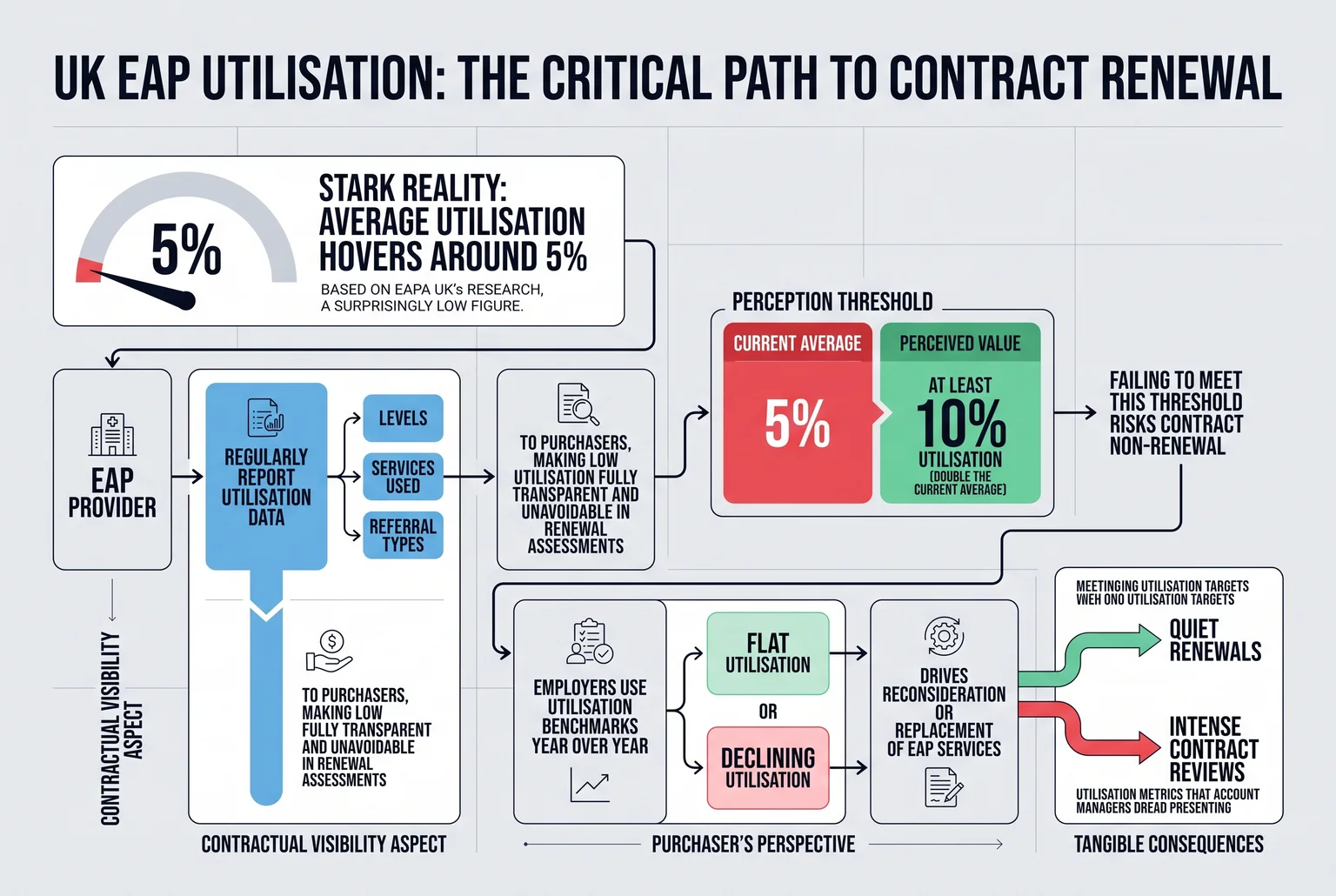
You already know the number your account manager dreads presenting. Utilisation across the UK EAP sector is widely reported to be low, with EAPA UK's own research putting the average at around 5%. That figure isn't a rounding error. It's the difference between a contract that renews quietly and one that gets picked apart in a review meeting.
Here's why it matters to you specifically, not just to the HR director who bought the service. EAPA UK's Standards require you, as the provider, to hand purchasers management information showing utilisation levels, services used, and referral types. You can't hide a weak number inside a glossy report. It's contractually visible, quarter after quarter, to the people deciding whether to renew with you or switch to a competitor.
And employers act on it. EAPA UK's own research found that some organisations have considered ending EAP contracts specifically because employees weren't using them. Separate purchaser guidance suggests employers increasingly benchmark utilisation year over year before renewal decisions, treating a flat or declining trend as a signal to redesign or replace the service rather than tolerate it.
There's also a perception threshold worth knowing. EAPA UK has reported that organisations typically only feel they're getting value once utilisation clears roughly 10% of the employee population, which is double the reported average. That gap between "we're providing a service" and "our client feels the service is worth paying for" is where contracts get lost.
This isn't a clinical failing. Your counsellors, your triage, your clinical governance can be excellent and the number can still sit at 5%, because the barrier isn't quality of care. It's whether employees ever hear about the service, trust it, or believe it's actually theirs to use.
Three barriers, not one problem
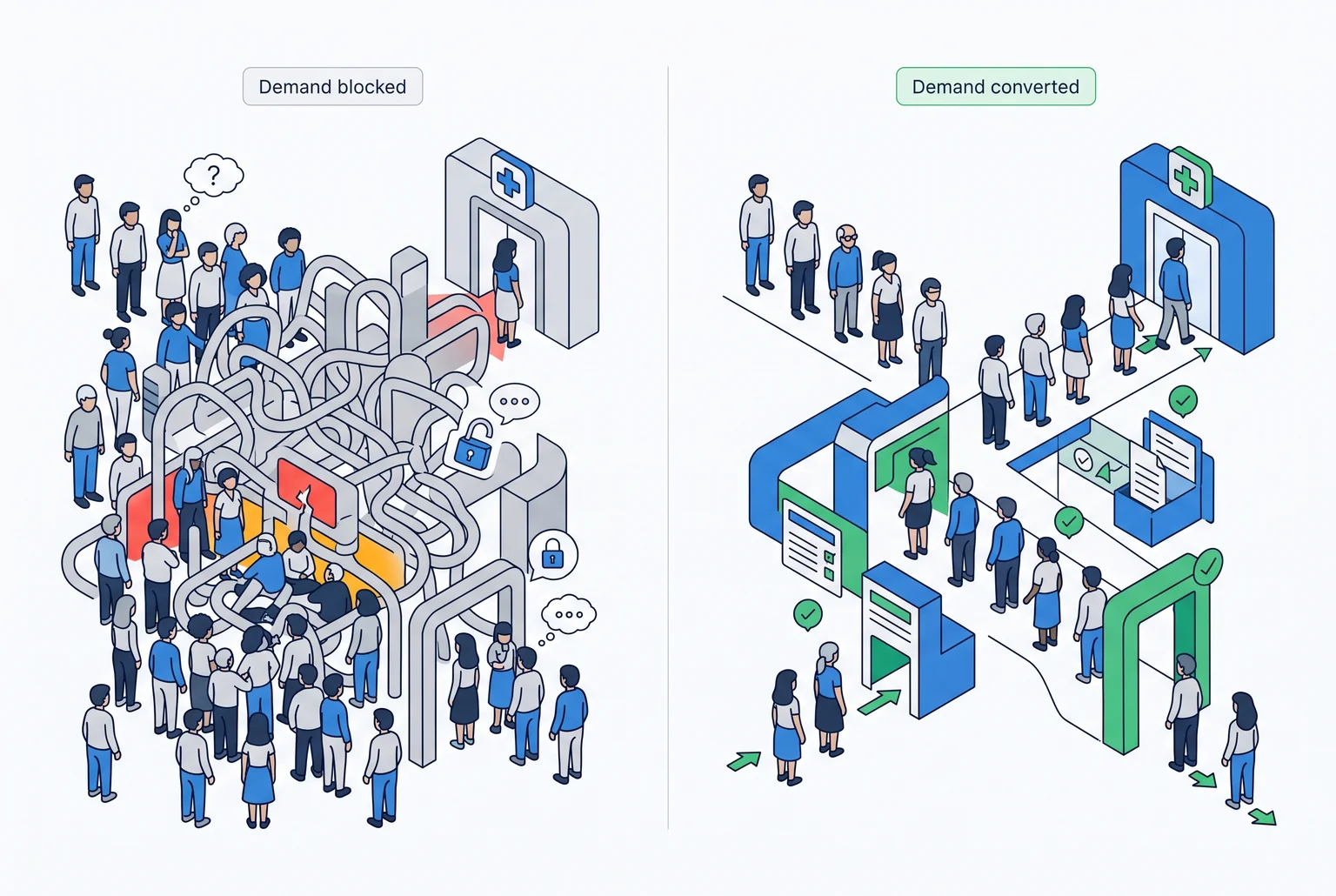
Every low utilisation number breaks down into the same three failures, and each one needs a different fix. Treating them as a single "awareness problem" is why so many campaigns underperform.
Reason one: employees don't know it exists. Research from Towergate Health and Protection found that 76% of organisations offer something like an EAP, yet only 5% of HR professionals believe it's actually used, and 15% of those surveyed pointed to poor communication and a lack of staff awareness as the cause. Separately, two-thirds of employees say they have no idea whether their employer offers an EAP at all. A one-off induction email doesn't survive six months of staff turnover, restructuring and inbox clutter.
Reason two: stigma makes asking feel risky. Mind's research into workplace mental health found that stigma keeps fewer than half of employees from seeking support at work in the first place, separate from whether they know the service exists. Would a graduate two months into their first job admit to a line manager that they need help? Would a senior manager, worried about how it reads at appraisal time? Acas's guidance on positive mental health at work is explicit that employers need to actively build an environment where asking for help doesn't carry a penalty, because the default workplace culture doesn't offer that safety on its own.

Reason three: employees don't trust that it's actually confidential. This is the one provider marketing teams underestimate most. Even employees who know the EAP exists and aren't held back by stigma may still not call, because they suspect their employer will find out they called, or worry about what gets reported back. This fear doesn't need to be justified by fact to suppress uptake, it only needs to feel plausible. And it does feel plausible: most employees have no clear picture of what management information actually contains versus what stays with the counsellor.
These three barriers stack. An employee can clear the awareness hurdle, push past the stigma, and still stall at the confidentiality question. That's the diagnosis behind every flat utilisation report you've ever handed a client, and it's why the tactics later in this guide are grouped by which barrier they're actually solving, not treated as one generic "raise awareness" push.
What data protection law actually restricts, and what it doesn't
Before you write a word of marketing copy, it's worth being clear on what UK GDPR governs here, because it shapes almost every tactic in this guide. This is general guidance, not legal advice, and any specific campaign involving health data should be checked with a qualified data protection adviser.
Information about someone's mental or physical health is special category data under the UK GDPR, and that classification applies whether the data comes from a clinical session note or from a marketing form asking someone to describe why they're getting in touch. Processing it requires two separate legal footholds: a lawful basis under Article 6, and a specific condition under Article 9. There are ten possible Article 9 conditions, but most EAP marketing activity will realistically sit under explicit consent or, for direct marketing specifically, consent is treated as the only realistic condition in most cases.
Consent for special category data has a higher bar than ordinary marketing consent. It has to be confirmed through a clear statement, specify exactly what kind of health data is involved, and be as easy to withdraw as it was to give. And in an employment setting, the ICO is blunt that consent is often shaky ground in the first place, because the power imbalance between employer and worker means people may not feel free to refuse.
This matters for a specific reason: any identifiable health information your service collects to deliver support to an employee should not quietly get repurposed to market to them or people like them. That repurposing needs its own lawful basis and Article 9 condition, not a borrowed one. If your marketing team wants to segment or personalise outreach based on who has used the service, treat that as a live compliance question, not a growth hack, and lean on anonymised or aggregated data wherever the objective can be met without identifying anyone.
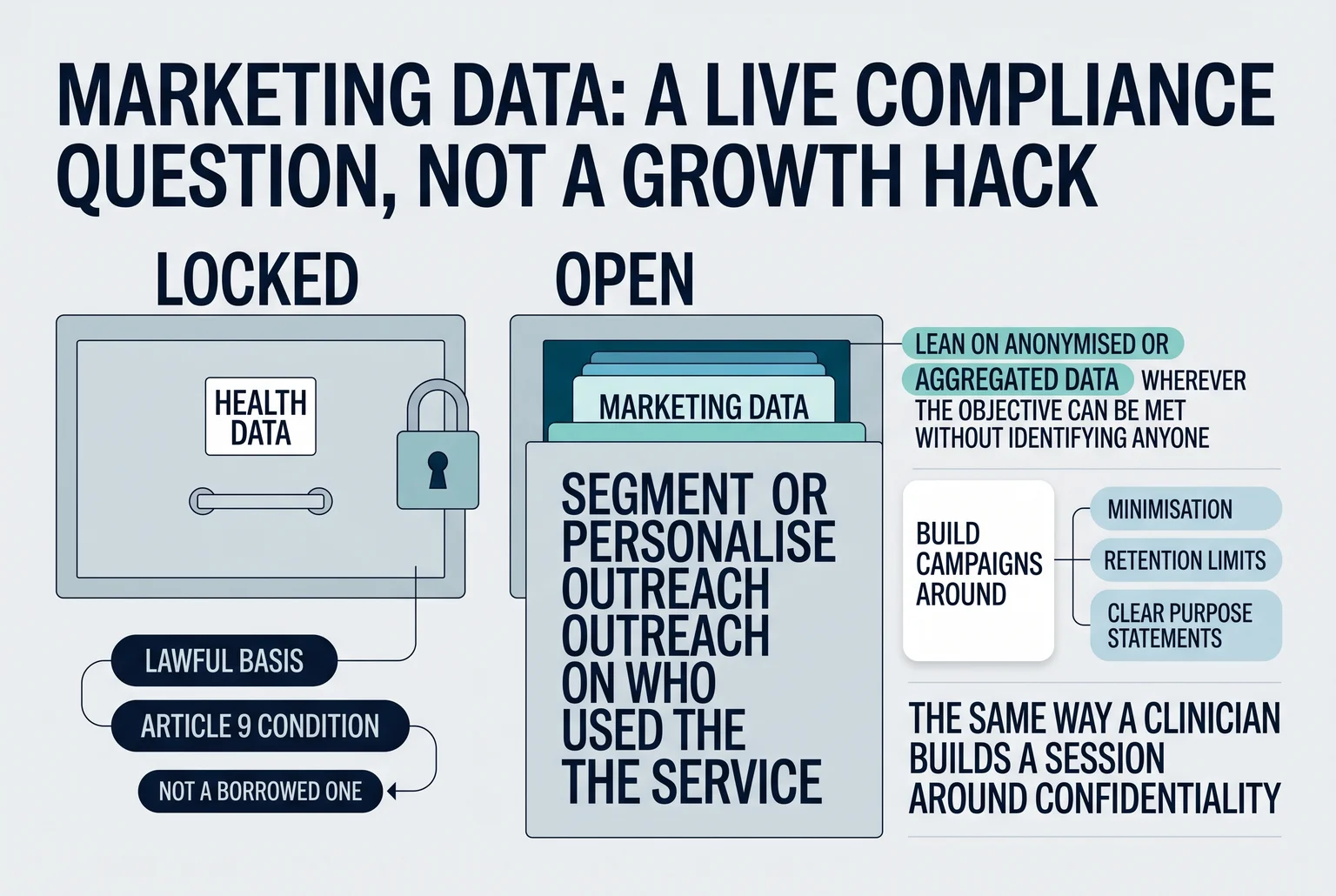
None of this is a reason to avoid marketing. It's a reason to build campaigns around minimisation, retention limits and clear purpose statements from the start, the same way a clinician builds a session around confidentiality. Competitors who skip this step move faster in the short term and carry more exposure in the long term. That gap is a genuine differentiator for providers who take it seriously.
Why "confidential" has to be your headline, not your footnote
What would it take for an employee to believe you, given that HR pays your invoice?
That's the barrier the earlier stigma-and-trust breakdown points to, and it's a specific, answerable one. Confidentiality concerns are consistently identified as a distinct reason people avoid EAPs, separate from general embarrassment about mental health, with one analysis putting the proportion of employees reluctant to seek help over privacy fears at around 40%. That figure deserves scepticism about precision, but the direction is hard to argue with: people worry less about what a stranger on a helpline thinks of them and more about what their manager will find out.
This is where most EAP marketing undersells itself. Providers lean on soft wellbeing language, an calming pastel background and phrase like "support when you need it", when the more persuasive claim is procedural: employers typically receive only aggregated figures, such as "47 employees used the service last quarter for stress-related issues", with no names, no session content, and no way to trace usage back to an individual.
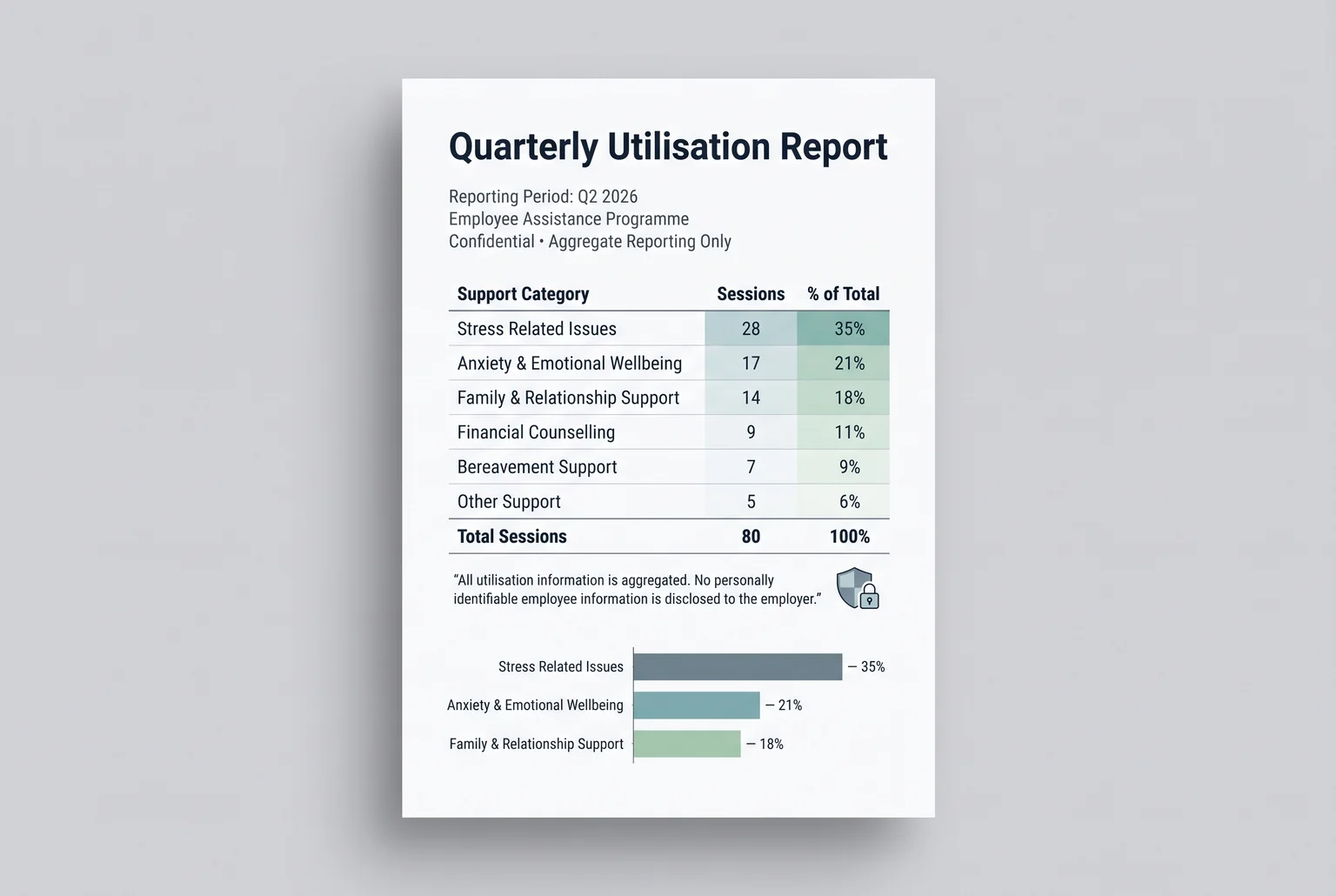
Say that plainly and specifically, and you're not writing a soft benefit. You're removing the actual objection.
Two conditions apply. First, describe your reporting practice exactly as it works, not as a generic industry norm, because contracts and referral processes vary. Second, this is also a retention lever with the employer, not just the employee: a provider that can demonstrate, concretely, how its reporting protects individuals gives HR directors a defensible answer when their own staff ask "who sees this."
Six tactics worth putting on your roadmap
Tactic one: train a network of manager champions, not just HR. Managers don't need to diagnose anything. Their job is to listen, ask open questions without interrupting, explore work adjustments and point people towards the EAP, in a private setting with enough time to actually talk. A good module covers scope and access, approved signposting language, and where confidentiality ends, because managers need a defined escalation route when there's a genuine safety concern. Role-play the handover from "I've noticed you seem stretched" to "have you thought about the EAP" until it stops sounding scripted. The caveat: managers should never ask whether someone used the service, request details of what was discussed, or log EAP contact anywhere near a performance file.
Tactic two: build EAP awareness into onboarding as a proper walkthrough, not a line item. Uprise Health recommends a full review of the benefit during induction, backed by a written guide the employee can go back to later.
Tactic three: repeat the message on a quarterly rhythm, at minimum, through newsletters, intranet posts and team meetings. Spill's guidance to promote the EAP at least once a quarter is a reasonable floor, not a ceiling, and multiple industry sources reject the idea that a one-off mention at induction does the job.
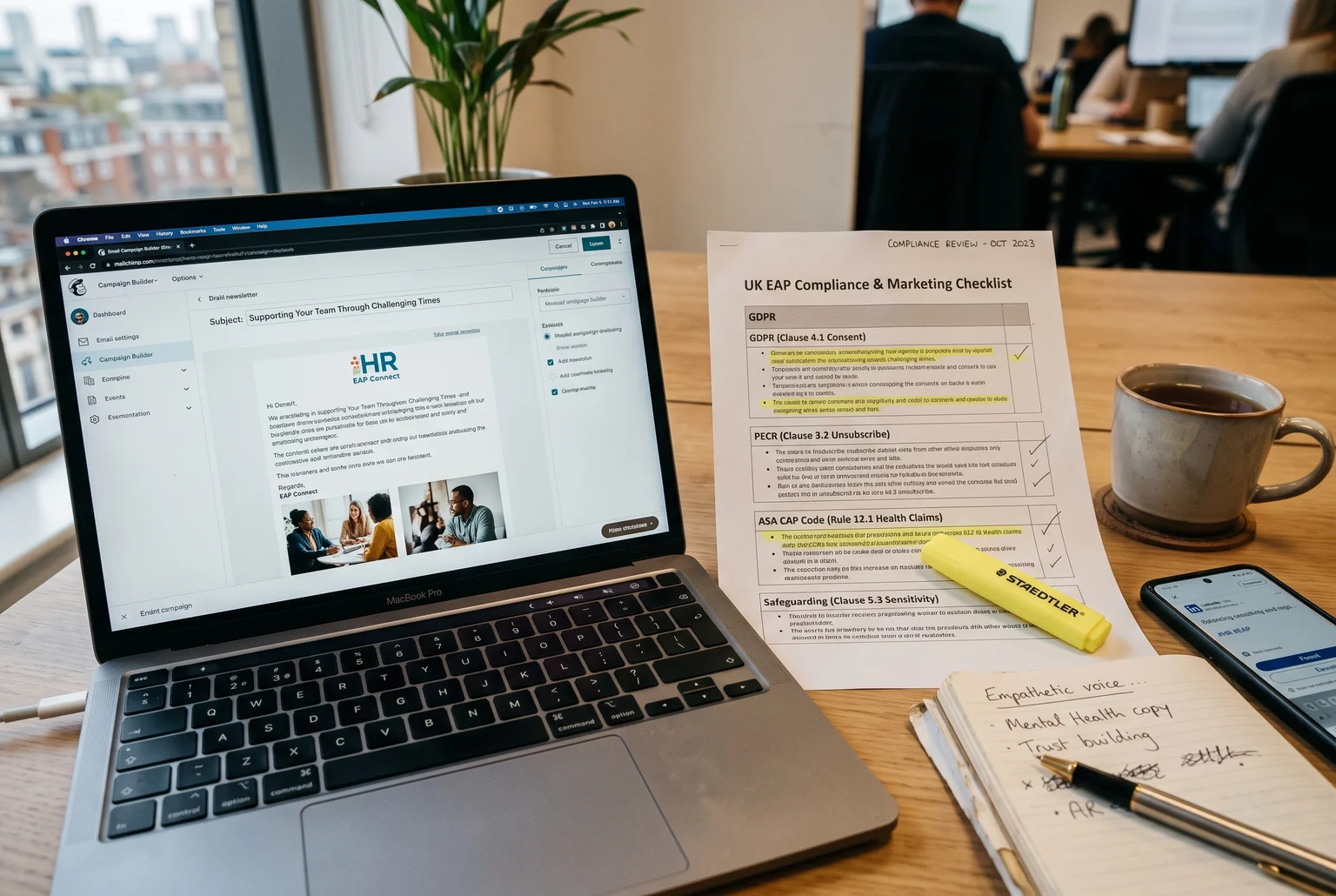
Tactic four: use anonymised or composite case studies, built the way the ICO's guidance on anonymisation describes, combining details from more than one real case, using broad role descriptors instead of specific job titles, and age ranges instead of exact ages. Label them explicitly as composite. Never let a testimonial imply a guaranteed outcome; the ASA's rules on testimonials require efficacy claims to be softened to subjective description unless they're backed by evidence.

Tactic five: co-brand the campaign with the employer's own HR team rather than running it as an EAP-only push. Research from the Work Foundation notes that HR managers see EAP promotion as a shared responsibility with the provider, and a joint campaign carries more legitimacy than one arriving solely from a third-party logo employees don't recognise.
Tactic six: adapt channels for shift workers and remote staff specifically, using home mailings, accessible-format materials and on-shift signage rather than assuming everyone reads the same intranet post. Barnett Waddingham's guidance on non-traditional employees is worth reviewing before finalising channel mix.
A checklist to run before any campaign goes live
Before signing off a campaign, whether it's your own or one built jointly with an employer client, run it against these guardrails.
Do:
- Use testimonials for authentic experience ("this helped me talk to someone when I needed to") rather than as proof of outcomes.
- Keep evidence that a testimonial is genuine and that you have permission from the person who gave it, along with a way to contact them.
- Treat any claim implying measurable results, symptom reduction, or effectiveness as an ordinary advertising claim that needs proper substantiation, not just a quote.
- Get specific, informed consent before naming or identifying a worker in promotional material, covering what it's used for, where it will appear, and how to withdraw.
- Build composite case studies properly if you're going anonymous: combine details from more than one real case, and check the result can't reasonably be traced back to one person.
- Keep health data collected to deliver support separate from data used to market the service.
Don't:
- Let a testimonial imply a cure, a guaranteed outcome, or a specific percentage improvement without objective evidence behind it. A testimonial alone is not that evidence.
- Assume a "case study" is automatically anonymous because you changed the name. If the role, department, or story details make someone identifiable to colleagues, it's personal data.
- Bundle consent for marketing use into unrelated paperwork, or make it hard for someone to withdraw once given.
- Disclose employee details to a third party for marketing purposes without clear, freely given opt-in from that employee.
- Reuse a real success story across channels without checking the original consent covered that specific use.

This is not legal advice. Treat it as a starting checklist and confirm specifics with your data protection officer or legal adviser before launch.
What better utilisation is worth to your firm, not just your client
You are the budget-holder here, so the case has to close on your P&L, not the employer's.
Most UK EAP contracts run on per-employee-per-month pricing, typically £0.40 to £1.25, regardless of how much the service gets used. A 500-employee contract at £1 PEPM brings in £6,000 a year whether utilisation sits at 3% or 12%. That fee is fixed. What isn't fixed is renewal risk, and that's where marketing spend earns its place on the budget line.
Say your firm holds twenty contracts averaging that £6,000 figure, roughly £120,000 in annual revenue. If poor utilisation causes even two clients to walk at renewal because they can't show their board the service is being used, you've lost £12,000 in confirmed revenue, plus the cost of replacing those contracts through new business. Set against that, a modest campaign budget aimed at raising visible engagement across your book looks like insurance, not overhead. That's illustrative arithmetic, not a guaranteed return.
There's a second return you can't put in a spreadsheet as easily: usage evidence and genuine engagement data become the raw material for the case studies and sector-specific proof points that win new pitches. Providers who can point to real activation, not just a service description, are pitching from a stronger position than those who can't.

Who should actually run this
None of the tactics above are exotic. They are, however, harder to execute correctly than they look, because worker health information sits inside special category data rules, direct marketing to those audiences carries its own conditions, and the CAP Code applies real scrutiny to anything resembling a health claim. Getting the lawful basis wrong, or letting a well-meaning case study slip into an implied outcome guarantee, isn't a hypothetical risk to file away.
This is why NHS-facing and healthcare marketing agencies exist as a distinct category rather than general agencies picking up health clients on the side. The skill isn't creativity. It's knowing where the line sits before you publish, not after a complaint lands.
If you're weighing whether to build this capability in-house or bring in support that already works inside these constraints, that's a fair question for any provider firm to ask. It doesn't need to be answered today.
Sources
- Two-thirds have no idea if employer offers an EAP — Personnel Today
- Missing the Mark: Why Staff are Rejecting Your Help (and what they really want) — Mind
- Special category data: A guide to lawful basis — Information Commissioner’s Office
- Plan direct marketing | ICO — ICO