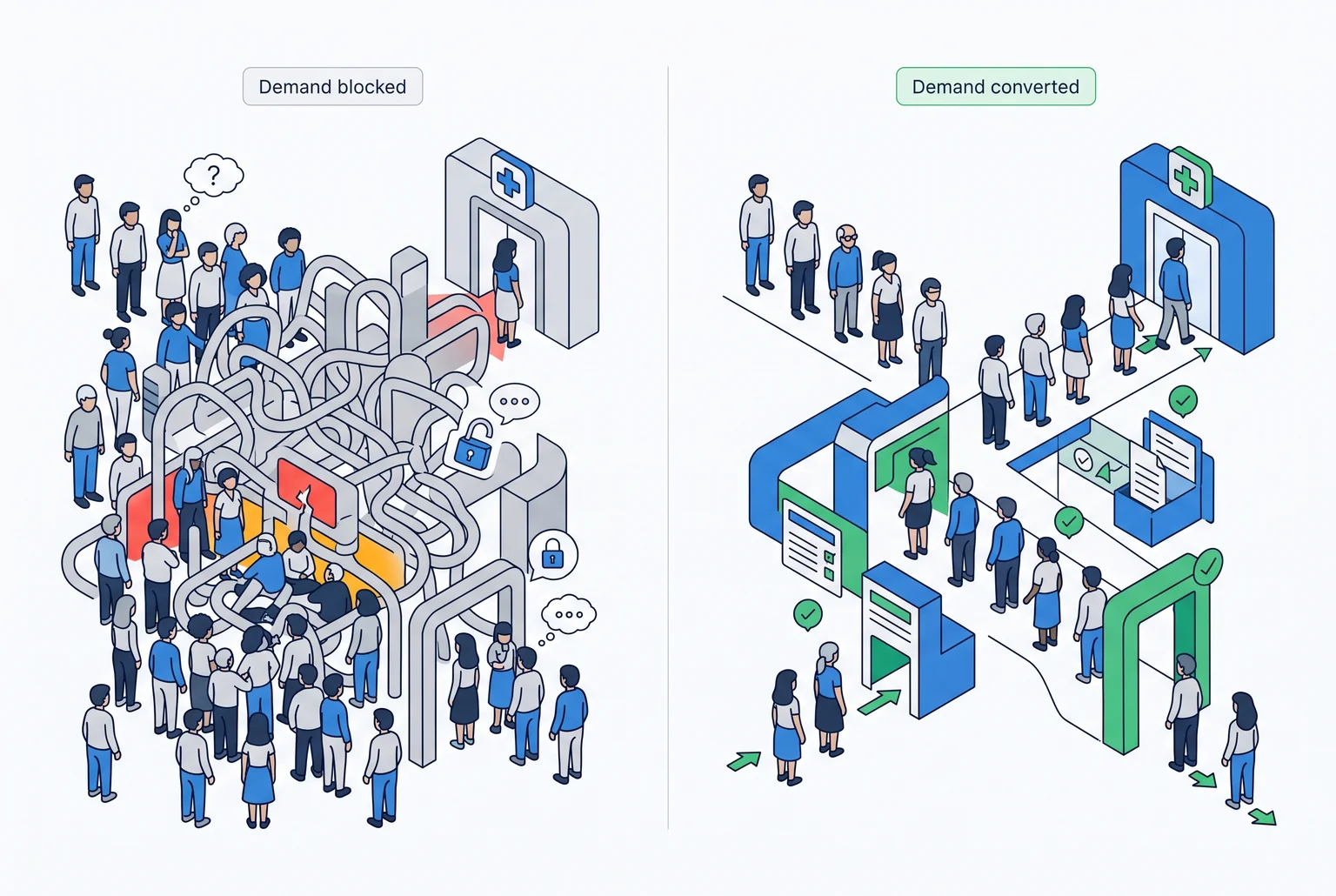


Why your best clinician can still run a half-empty diary
A mother in Guildford spends her Sunday evening searching for someone who can assess her nine-year-old for autism. She finds three clinics with near-identical websites: same stock photography, same reassuring language about "child-centred assessment," same fee schedule. She emails all three at 9.40pm.
One replies at 8.15 the next morning. One replies at 4pm. One replies two days later, apologetically, from an inbox nobody checks over weekends.
She books with the first one. Not because its psychiatrist is more qualified. She has no way of judging that from an email. She books because someone answered while she was still anxious enough to act.

This is not a hypothetical drawn from nowhere. Research into UK medical clinics has quantified exactly this pattern. An analysis of 48,000 enquiries sent to aesthetic clinics through WhatClinic found that failing to respond within a single day cut the probability of booking by 42%. A separate clinic-marketing analysis puts the gap even starker: roughly 42% of enquiries convert when answered within five minutes, falling to around 18% within the half-hour to one-hour window, and down to 9% for anything answered between one and four hours later. The often-quoted "hundred times more likely" and "twenty-one times more likely" figures for five-minute response speed trace back to a 2007 MIT and InsideSales.com study, not to the frequently cited Harvard Business Review analysis, which is a separate piece of work: a 2011 audit of 2,241 US companies co-authored by James Oldroyd, which found the average firm took 42 hours to respond to a web-generated lead in the first place. These are different studies measuring different things, and they should not be quoted as if one confirms the other. What they agree on, from separate datasets a decade apart, is the direction: speed converts, and most organisations are slow.
Nothing in that mother's decision touched on clinical quality. She never saw a CV, a qualification, a supervision record, or a outcome measure. She saw who replied first.
This is the structural fact clinic leaders resist: clinical governance and enquiry conversion are governed by entirely different mechanisms. One is built through training, supervision, and audit. The other is built through response systems, positioning, and visibility. A psychiatrist can hold every relevant qualification and still lose the enquiry to a less experienced clinic that happens to answer its phone.
Marketing spend does not fix this. A better website does not fix this if the enquiry still sits unanswered for two days. The fix has to happen in the machinery behind the marketing, not the marketing itself, and it has to happen in a particular order.
Why the diary problem is getting worse, not better
Three separate pressures are converging on this sector at once, and none of them are going away.
The first is demand. NHS waiting lists for ADHD assessment have pushed a substantial share of diagnostic work into private hands: analysis from the Independent Healthcare Providers Network puts the independent sector's share at at least 50% of all NHS ADHD assessments and over a third of autism assessments. Worth flagging: national waiting-list figures for ADHD are not a single clean dataset. Numbers quoted in the hundreds of thousands are official NHS estimates stitched together from partial reporting, not a complete census, and anyone quoting a precise figure with confidence is smoothing over gaps that genuinely exist.
The second is competitive density in talking therapies. Membership of the British Association for Counselling and Psychotherapy alone reached 70,000 members in the 2023 to 2024 year, and that's one body among several. Meanwhile "counsellor" and "psychotherapist" remain unprotected titles in UK law. The Health and Care Professions Council itself confirms that these professionals aren't required to sit on any statutory register to use those titles, and government has stated plainly that it has no current plans to change that. A crowded market with no title barrier to entry means clinical credentials do less work in a first search than clinic leaders assume.

The third is a shifting line between assessment and treatment in how providers are regulated. Sector commentary has pointed to a regulatory distinction turning partly on whether a provider delivers treatment alongside assessment, or diagnosis only, with some industry discussion referencing a CQC registration change taking effect around March 2026 for diagnosis-only ADHD and autism providers. I haven't independently verified the specifics of that change, and readers should check current CQC guidance directly rather than treat this as settled. What's clear from CQC's own published scope-of-registration material is that the diagnosis/treatment distinction already matters to how providers are classified, and any tightening or loosening of that line changes what a "registered" badge signals to a worried parent doing due diligence at 9.40pm.
Six stages, one fixed order
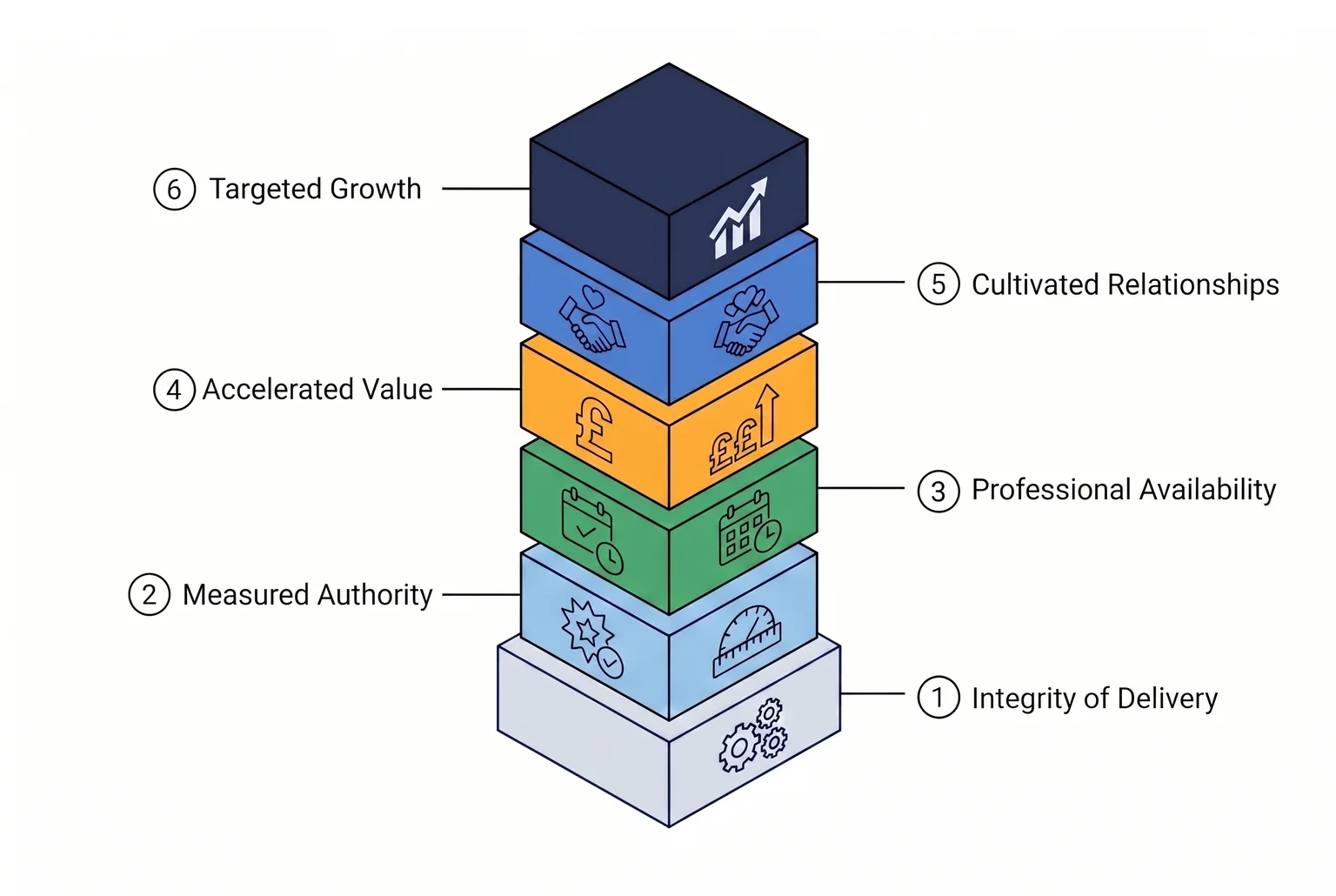
None of the pressures described above are solved by a single fix. A clinic can have a compliant website, a fast reply system, and a strong referral network, and still lose enquiries if any one of these is missing or built out of order. The Practice IMPACT Protocol names six stages that sit underneath enquiry flow, each resting on the one before it.
Integrity of Delivery asks: does everything a prospective client sees match what actually happens in the room? This covers accurate positioning, honest scope-of-practice claims, and consistency between marketing and clinical reality.
Measured Authority asks: can a stranger tell, within thirty seconds, why this clinic is credible? This is about credentials, regulatory status, and evidence of standing, displayed in ways that hold up under scrutiny.
Professional Availability asks: what happens in the gap between enquiry and first human contact? Response speed and accessibility sit here.
Accelerated Value asks: does the enquirer understand what they get, and when, before they commit? This covers the clarity of the enquiry-to-booking journey.
Cultivated Relationships asks: what happens after the first booking, and who refers in besides the client themselves? Retention and professional referral sit here.
Targeted Growth asks: where is deliberate effort and spend best directed, once the first five stages are sound?
The order is not arbitrary. Spending on Targeted Growth while Professional Availability is broken means paying to generate enquiries that then sit unanswered. Building Measured Authority on top of weak Integrity of Delivery means presenting a version of the practice that will not survive first contact. Each stage is a precondition for the next one working at all.
The next two sections walk through each stage in turn, in this fixed order, with separate guidance for diagnostic clinics and for group and multidisciplinary therapy practices, since the practical steps differ even where the underlying question is the same.
Building the base: what has to be true before you spend a penny on visibility
Integrity of Delivery asks whether what a prospective client sees before they book matches what happens once they are in the room. For diagnostic clinics, this means checking that assessment scope, waiting times, and fees on the website match what intake staff tell callers. A page advertising "assessment within two weeks" while the real wait is six is not a small inconsistency; CAP rules require that marketing communications do not materially mislead. For group therapy practices, the same principle applies to associate bios: listing a modality an associate isn't currently trained or supervised to deliver is a scope-of-practice problem before it's a marketing one.
At the very least: audit your website against your actual intake script once a quarter, and correct any claim about speed, scope, or price that no longer matches reality.
Measured Authority
Measured Authority asks whether a stranger can establish, within thirty seconds, why this clinic or practice is credible. Testimonial rules diverge sharply by professional body, and conflating them is a real risk. UKCP's Code of Ethics and Professional Practice prohibits members from using client testimonials in any advertising, including Find a Therapist profiles. The British Psychological Society's guidance similarly advises against testimonials in advertisements, framed around honesty and avoiding misleading claims rather than a single blanket ban. No equivalent explicit prohibition turned up for BACP or ICF members, so practices with mixed membership should check the specific code each clinician sits under rather than assume one rule covers the whole team.
Where testimonials aren't permitted, authority has to come from elsewhere: registration numbers, supervision arrangements, published CPD, and professional body membership displayed accurately and without embellishment.

At the very least: for diagnostic clinics, list every clinician's regulatory registration number and specify who holds overall clinical responsibility. For group practices, confirm which professional bodies govern each associate and remove any testimonial that a member's code prohibits, even if it's sat on the site for years.
Professional Availability
Professional Availability asks what happens in the gap between enquiry and first human contact. Harvard Business Review's lead-response research found that contacting a lead within an hour made a sales rep nearly seven times more likely to have a meaningful conversation than waiting even slightly longer, and later analyses of that dataset put average first-reply times across sectors at roughly 42 hours. Mental health enquiries aren't sales leads, but the underlying behaviour, a parent or patient contacting several providers at once and booking with whoever answers first, doesn't change because the service is clinical.
Diagnostic clinics handling ADHD and autism enquiries face particular pressure here given demand outpacing NHS capacity. Group practices face a different version: enquiries often need routing to the right associate by modality, which can slow response further if no one owns that step.
At the very least: assign a named person, or a defined rota, responsible for acknowledging every enquiry within one working day, and track how long that actually takes.
Turning enquiries into a stable diary, then keeping it stable
Accelerated Value asks what happens between "yes, I'd like to book" and the first paid session. For diagnostic clinics this gap often includes a deposit, an intake form, and a wait for the next available slot; every extra step is a point where a parent chasing an ADHD assessment for their child can drift back to Googling alternatives. For group practices, it includes matching the enquirer to the right associate by modality and availability, which frequently stalls if intake and clinical scheduling sit in separate systems.
At the very least: map every step between "enquiry received" and "first session paid for," and remove any step that exists for administrative convenience rather than clinical necessity.
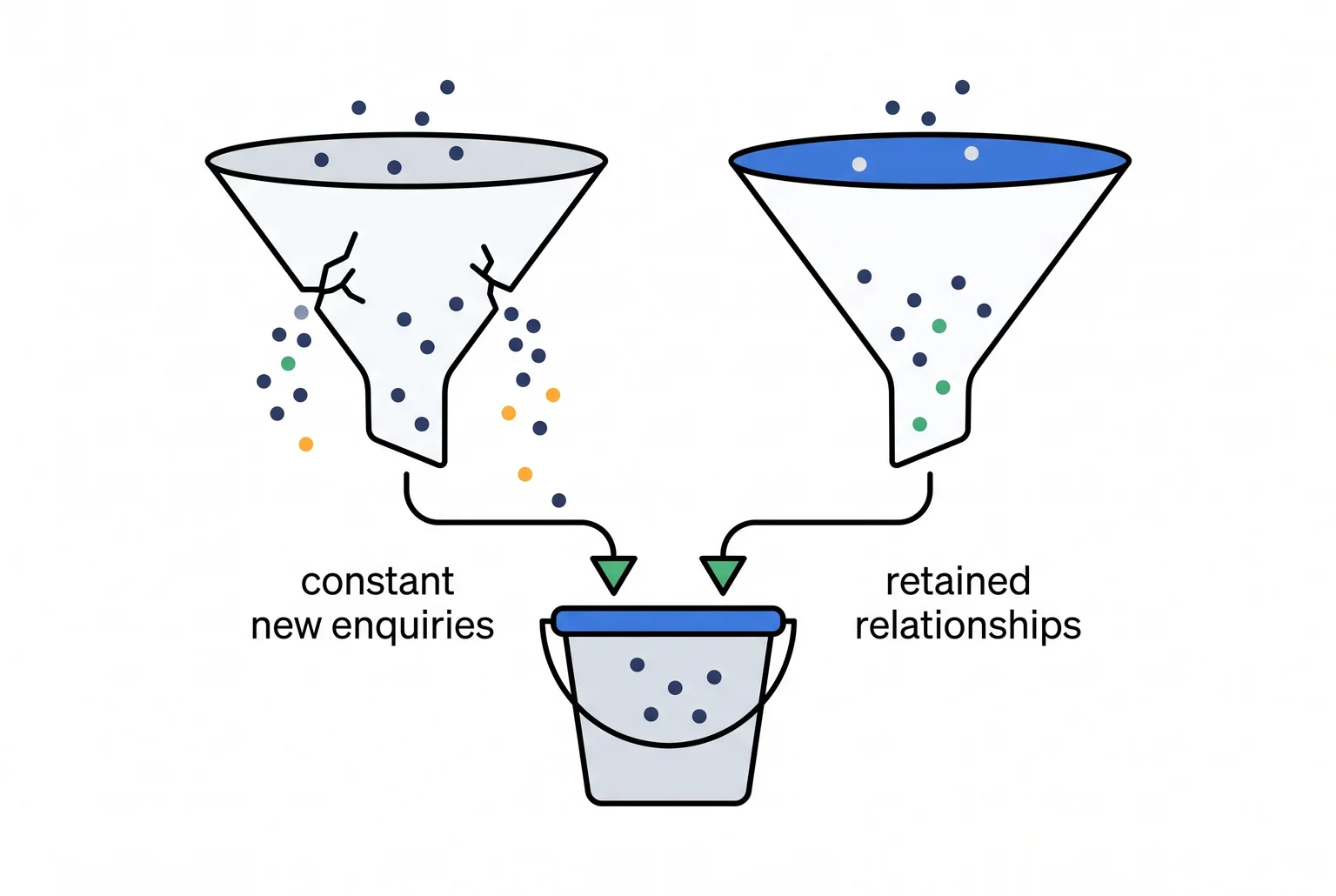
Cultivated Relationships asks what happens after the first booking, and this is where the commercial case for retention gets concrete. Harvard Business Review's 2014 brief by Amy Gallo cites research suggesting that acquiring a new customer can cost five to 25 times more than retaining an existing one. Frederick Reichheld and W. Earl Sasser's original 1990 Harvard Business Review study, later summarised in Bain's Loyalty Rules, found that a five-percentage-point improvement in retention was linked to profit increases of 25% to 95% across the industries examined, with individual case examples ranging from 30% in an auto-service chain to 125% at MBNA. These are general commercial findings, not sector-specific data for mental health or diagnostic services, but the underlying logic transfers: a diagnostic clinic that keeps families for follow-up reviews and titration, or a therapy practice that retains clients across a course of sessions and generates GP or self-referral repeat business, is working with fundamentally cheaper economics than one constantly chasing first-time enquiries.
At the very least: build a simple system for staying in professional contact with past clients, whether that is a review reminder, a newsletter compliant with PECR consent rules, or a structured referral pathway to allied clinicians.
Targeted Growth asks where deliberate spend and effort belong once the first five stages hold. Increasingly, that includes generative engine optimisation, the practice of structuring content so that AI systems such as ChatGPT, Gemini, and Perplexity can find, understand, and cite it when synthesising an answer rather than just listing links, as several business-school explainers on the emerging discipline describe. For healthcare providers specifically, that guidance points to explicit, verifiable service pages: named specialties, clinician credentials, locations, conditions treated, and clear access information. Nobody has published controlled evidence on how often UK parents or patients now ask an AI assistant to shortlist a clinic, so treat this as an emerging visibility factor to monitor, not a proven channel.
At the very least: check what a generative AI tool currently says about clinics or practices like yours, and see whether yours is mentioned at all.
Three rulebooks, not one, and they overlap in specific ways
Every stage above sits inside three sets of rules operating at once, and they don't map neatly onto each other.
CAP Code Section 12 governs healthcare advertising claims: objective claims about outcomes need substantiation, typically through evidence such as trials, and nothing in this protocol changes that. No stage described here is a route around it. Any wording implying guaranteed or superior clinical results is out, regardless of how the enquiry-flow system performs.
UK GDPR and PECR govern how you contact people. Email and SMS marketing generally need explicit, affirmative consent, not a pre-ticked box, and appointment reminders sit in a different category from newsletters or re-engagement campaigns, so your CRM needs to separate service communications from marketing. Record what was agreed, when, and for which channel.
Professional frameworks add a third layer. The GMC and HCPC both require registrants to take reasonable steps to ensure promotional content is accurate and not misleading, which sits above whatever your marketing platform allows technically.
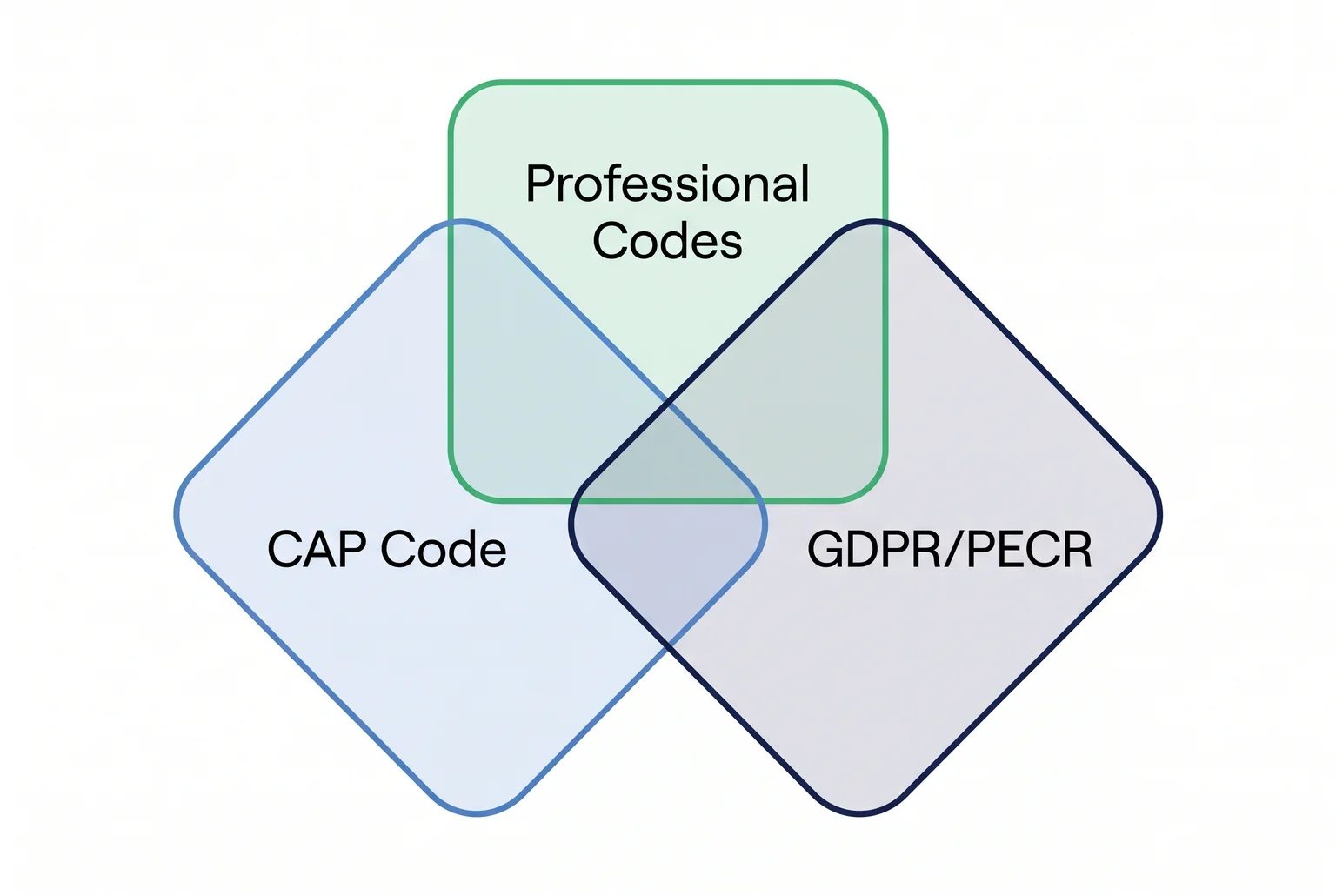
At the very least: before publishing anything, check it against all three, not just the one you know best.
Why the diary and the clinical work follow different rules
An empty diary in a clinic with strong outcomes and satisfied patients is not evidence of weak clinical work. It is evidence that enquiry flow runs on its own logic, separate from clinical competence, and that logic has to be built deliberately.
The Practice IMPACT Protocol sets out that logic as six stages, each resting on the one before it: Integrity of Delivery asks whether the operational basics hold up under scrutiny. Measured Authority asks whether expertise is demonstrated within the rules that govern your title and profession. Professional Availability asks whether a genuine enquirer can reach you fast enough to matter. Accelerated Value asks whether the path from first contact to booked assessment is short and clear. Cultivated Relationships asks whether existing patients and referrers become a source of further enquiries. Targeted Growth asks where spend belongs once the first five are sound.
Spending on the last stage before fixing the first is the reason many marketing budgets in this sector produce so little.
Sources
- The Short Life of Online Sales Leads — Harvard Business Review
- The truth about ADHD waiting times and the independent sector – Independent Healthcare Provider Network — Independent Healthcare Providers Network
- BACP Year of impact 2023 to 2024 — British Association for Counselling and Psychotherapy
- Understanding the regulation of psychologists | The HCPC — Health and Care Professions Council
- Written questions and answers — UK Parliament
- 25+ Customer Retention Statistics, Churn & LTV Data (2026) — 99 Coupons Journal — 99 Coupons
- Loyalty Rules! – Bain & Company — Bain & Company
- 12 Medicines, medical devices, health-related products and beauty products – ASA | CAP — ASA | CAP
- Plan direct marketing — Information Commissioner’s Office
- Using social media as a medical professional – GMC — General Medical Council (GMC) and Health and Care Professions Council (HCPC)