

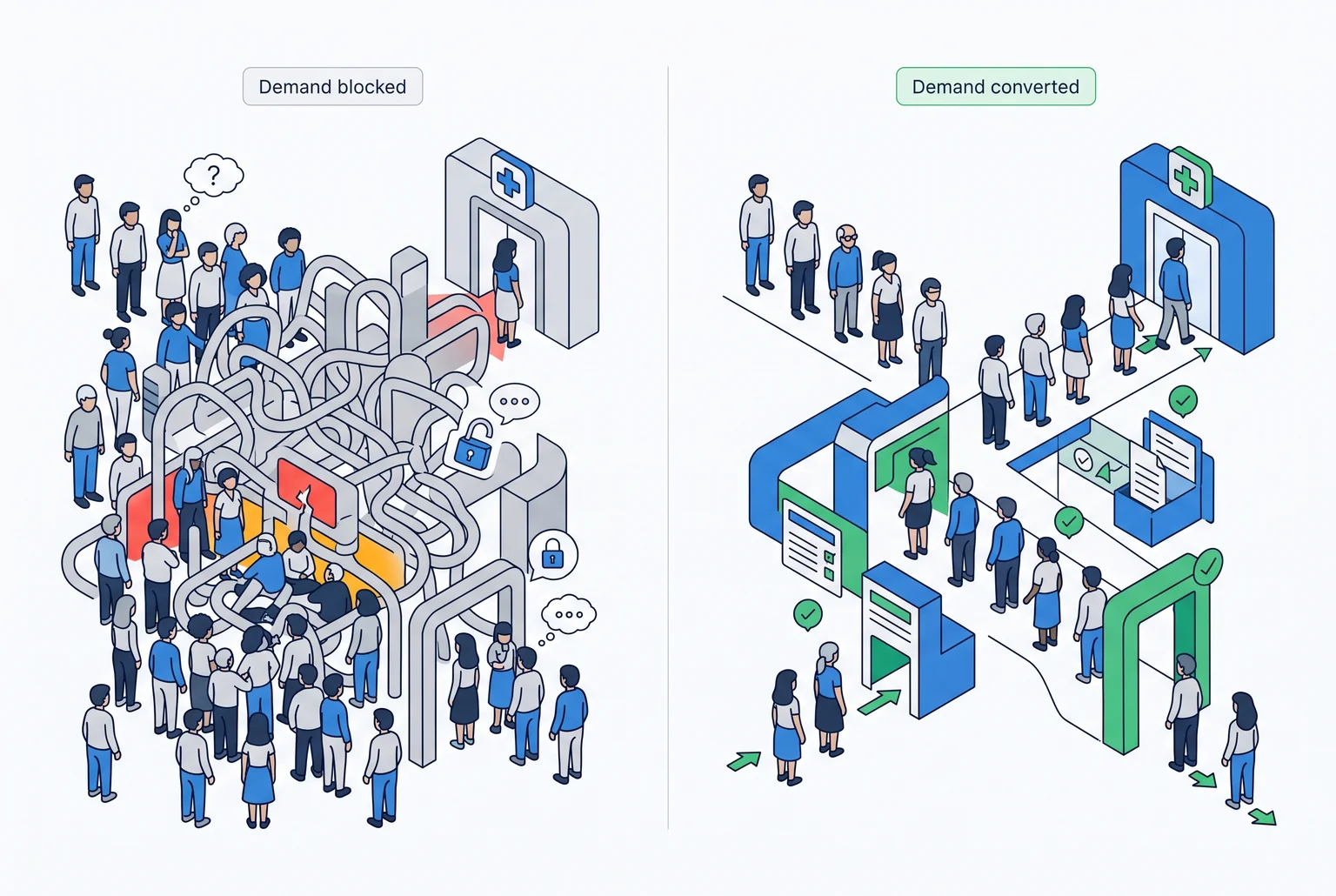
Demand is exploding. Growth isn't.
Here's the number that should stop any clinic owner mid-scroll: 562,450 open referrals for a possible ADHD diagnosis in England as of December 2025, with 70.6% of those adults, according to House of Commons Library analysis of NHS England data. Children waiting for assessment have grown from around 21,000 in April 2019 to roughly 270,000 by December 2025.
That's not a market. That's a queue the length of a small city.
Private providers should be thriving. And in aggregate, the money says they are: NHS-funded spending on private ADHD service providers rose from about £16 million to £58 million across 19 ICBs in three years, a 255% increase, according to a Centre for Health and the Public Interest report. Private providers' share of ADHD medicine supply climbed from 8% to 14.5% between Q1 2023 and Q2 2025, per IQVIA analysis.
So the sector is growing. The paradox is that individual clinics often aren't, or not as fast as the numbers above suggest they should.
Talk to clinical directors running private ADHD services and a different picture emerges: enquiry volumes that plateau despite NHS waiting times stretching past four years for children and eight years for adults in some areas, associate diaries with unfilled slots next to a five-year NHS backlog, marketing spend that produces phone calls but not conversions. The demand is real. The referrals exist. The clinic still isn't growing at the rate the underlying market would predict.
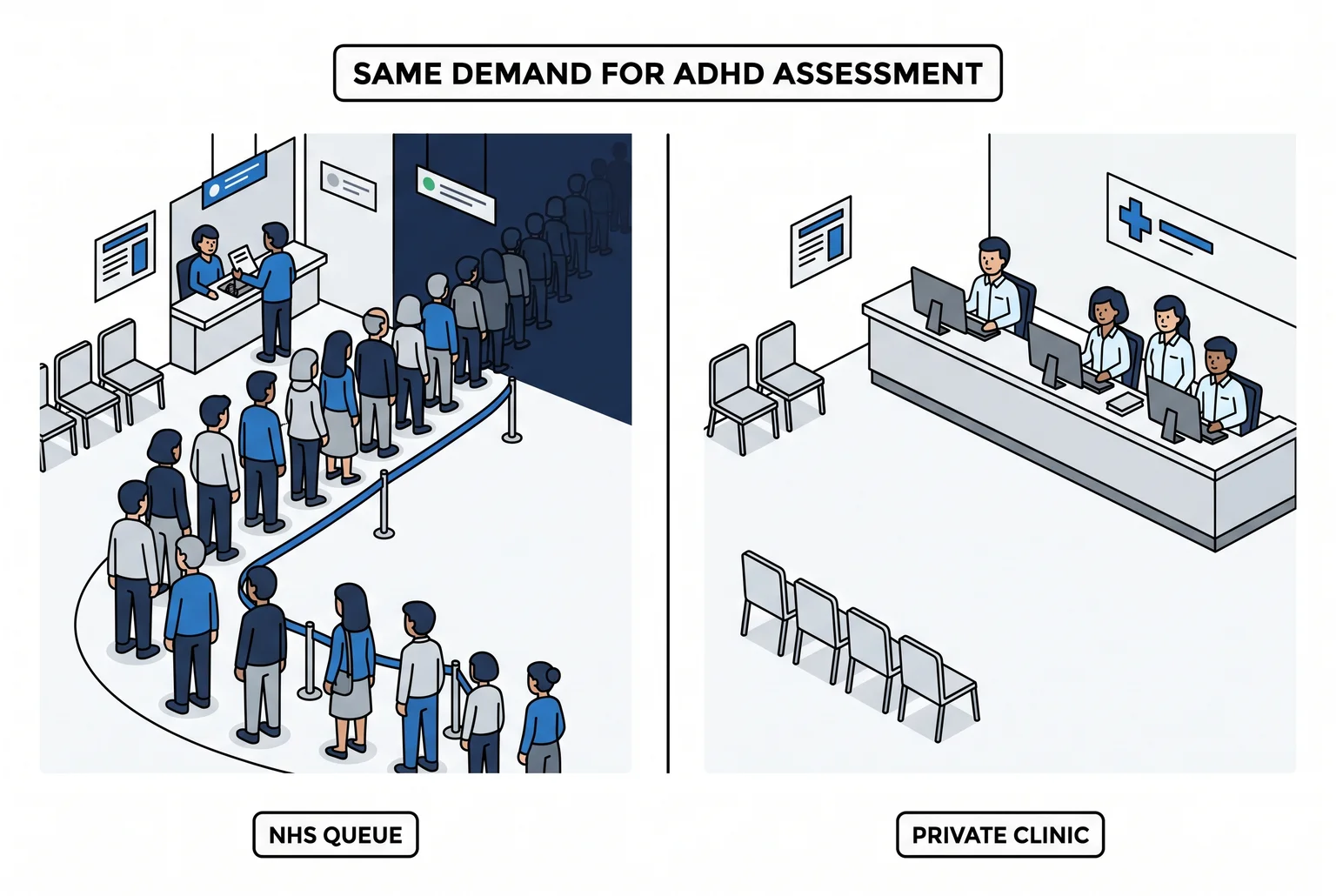
This is the puzzle worth taking seriously, because the answer isn't "there's no market" and it isn't "clinical quality doesn't matter." It's that structural, regulatory, and reputational friction sits between a family googling "private ADHD assessment near me" and that family actually booking with a specific, well-run clinic. Advertising rules restrict what you can say. Oversight gaps mean quality signals patients used to trust have weakened. Social media has made ADHD both more visible and more contested. And most clinics are running marketing built for a local competitor, in a market that's gone national.
The rest of this piece works through each of those barriers in turn, then sets out what a compliance-aware marketing system does to remove them one at a time.
Right to Choose has turned your local market into a national one
Right to Choose is a legal mechanism, not a marketing gimmick. Under NHS England rules, a patient registered with an English GP can ask to be referred to an NHS-contracted provider for their first outpatient ADHD assessment, anywhere in the country, and the GP must make that referral rather than rejecting it on cost or convenience grounds, according to guidance from Nottingham and Nottinghamshire ICB.
That single clause has rewired the competitive map. A parent in Hull can choose a provider based in Hove. A GP surgery in Liverpool has no obligation to keep the referral local at all: a freedom of information response from Cheshire and Merseyside ICB recorded 2,858 patients choosing a non-local provider for ADHD assessment or treatment between 2020/21 and 2022/23 alone.

A Medway ICB paper covering 2024–25 describes demand for adult neurodevelopmental services rising rapidly and unexpectedly since 2022, with 71% of that demand tied to ADHD assessment and medication reviews, and it notes that the number of providers offering assessment and prescribing privately or through Right to Choose has grown sharply alongside it. More provider choice for patients means more provider competition for clinics, and that competition is no longer confined to the next postcode.
This is where clinical excellence stops being sufficient on its own. A well-run clinic in a mid-sized town can run a spotless service, get every diagnosis right, and still watch enquiries drift to a competitor three hundred miles away that shows up first when a parent or GP searches online. Comparison sites already exist for exactly this purpose, listing provider wait times against each other nationally, with reported ranges from around one week to 78 weeks depending on provider, though these figures aren't independently verified. Patients are shopping providers like they'd shop insurance.
So the question isn't whether your clinic is good enough to win the referral. It's whether you're even in the conversation when the choice gets made. Which brings us to why so many otherwise excellent clinics aren't.
Four barriers that keep excellent clinics invisible
Clinical quality doesn't show up in a Google search. Four structural problems sit between your clinic and the patients already trying to find you.
Barrier one: you can't advertise the thing you do best. The ASA treats ADHD as a serious condition, meaning ads cannot offer advice, diagnosis or treatment for it unless conducted under the supervision of a suitably qualified medical professional, according to ASA and CAP guidance. Two rulings show this isn't theoretical. In February 2024 the ASA held against Happyo on exactly this basis, and a 2026 ruling against Cloud Nine repeated the same finding almost word for word. Claims that a product or service can help with ADHD, support people with it, or reduce symptoms are treated as disease-treatment claims and risk breaching the Code. That rules out the plain-language marketing language every other sector uses freely: "we help with focus", "reduce ADHD symptoms", anything that reads as a treatment promise rather than a description of a supervised clinical service.
Barrier two: the quality signal patients used to rely on has gone. From 26 March 2026, CQC guidance confirms that providers offering only diagnosis of ADHD and autism, without treatment, prescribing or titration, do not need to register with the CQC. Registration still applies to services offering ongoing treatment, but diagnosis-only clinics, which is much of the private ADHD market, sit outside CQC oversight entirely. For years, "CQC registered" was the shorthand a worried parent or GP used to separate serious providers from opportunists. That shorthand no longer works reliably, which pushes the burden of proving legitimacy onto the clinic itself, through content, credentials and transparency rather than a badge.
Barrier three: the loudest voices in the room aren't clinicians. A 2026 systematic literature review found that between 48.7% and 92% of the most-viewed ADHD videos on TikTok contain misleading information, and a separate study of the #ADHDtest hashtag found 92% of the videos analysed were misleading. A 2022 study of 100 ADHD TikTok videos classified 52% as misleading. Whatever the exact figure, the pattern is consistent across independent studies: TikTok is where a large share of prospective patients form their first impression of ADHD, and that impression is often wrong before they've spoken to a clinician.
Barrier four: nobody in the building has time to fix any of this. Compliance-aware copy, CQC transparency, and correcting misinformation all take specialist skill that most clinical directors were never trained in and don't have hours to build from scratch, on top of running assessments.
A second regulator nobody budgets for
ASA and CQC get the attention because they're visible in the sales pitch: what you can claim, whether you carry a badge. UK GDPR and PECR sit underneath both, governing something quieter: what you're allowed to do with a person's contact details once they've enquired.
Get this: ADHD-related information is health data. The ICO defines health data as anything revealing a person's physical or mental health status, including information from which it can be inferred, and that reaches further than diagnosis letters. A booking for an ADHD assessment, a screening questionnaire, a note that someone rescheduled their titration review, all of it counts. Article 9 of UK GDPR prohibits processing special category data by default, and clinics need both an Article 6 lawful basis and a separate Article 9 condition to touch it. The ICO's own guidance is blunt about which condition applies to marketing: you should have explicit consent, because it's unlikely any other special category condition applies. Legitimate interests, the basis most businesses reach for by default, does not clear this bar.
That rules out a lot of standard patient-acquisition tactics done casually. Retargeting someone who visited your ADHD assessment page, then following them around the internet with an ad, means processing data that reveals their health interest, not something you can justify on implied consent. Testimonials naming a diagnosis need the same explicit consent, tracked, not assumed.
PECR then adds a separate layer on top for email and SMS. Sending marketing messages requires prior opt-in consent, with a narrow soft opt-in exception only for a clinic's own previous customers marketing similar services, and only where opt-out was offered at collection and in every message since, per ICO guidance. Bought-in or shared lists are explicitly excluded from that exception. Every person on the list needs to have specifically consented to that message from that specific clinic; consent doesn't transfer.

None of this closes off growth. It closes off the tactics that were always weakest against a health-literate regulator, and points toward the one channel where consent barely enters the equation: content that patients find and read before they've handed over any data at all.
Six places the enquiry drops before it reaches you
Every barrier discussed so far becomes concrete in the same place: a clinic's actual online footprint. These are the recurring, fixable gaps, mapped to what they cost.
|
Problem |
Where it shows up |
Enquiry impact |
|---|---|---|
|
Local SEO / Google Business Profile |
Wrong or generic category ("Medical Clinic" instead of the specific service), missing attributes like "accepts new patients," fewer than 10 photos |
Reduced map-pack visibility; profiles with 30+ photos get 42% more website clicks and 35% more direction requests than thin profiles |
|
Messaging |
Generic homepage copy that doesn't speak to ADHD-specific concerns or answer the first question a parent or adult patient has |
Visitors bounce to a competitor whose page answers the question directly |
|
Reviews |
No system for collecting reviews, no responses to existing ones |
Weaker trust signals and lower local ranking, since practices that actively manage reviews outperform those that ignore them |
|
Technical SEO |
Slow mobile pages, missing metadata, no location-specific landing pages |
Direct traffic loss, given that poor mobile experience is a recurring cause of lost patients |
|
Content |
No condition-specific pages, or templated pages that just swap a city name |
Google penalises thin duplicate pages, and genuinely useful condition guides drive measurable organic growth elsewhere in healthcare |
|
Tracking / CRM |
No visibility into which channel produces bookings versus abandoned enquiries |
Marketing spend allocated blind, with no data to separate a working channel from a wasted one |
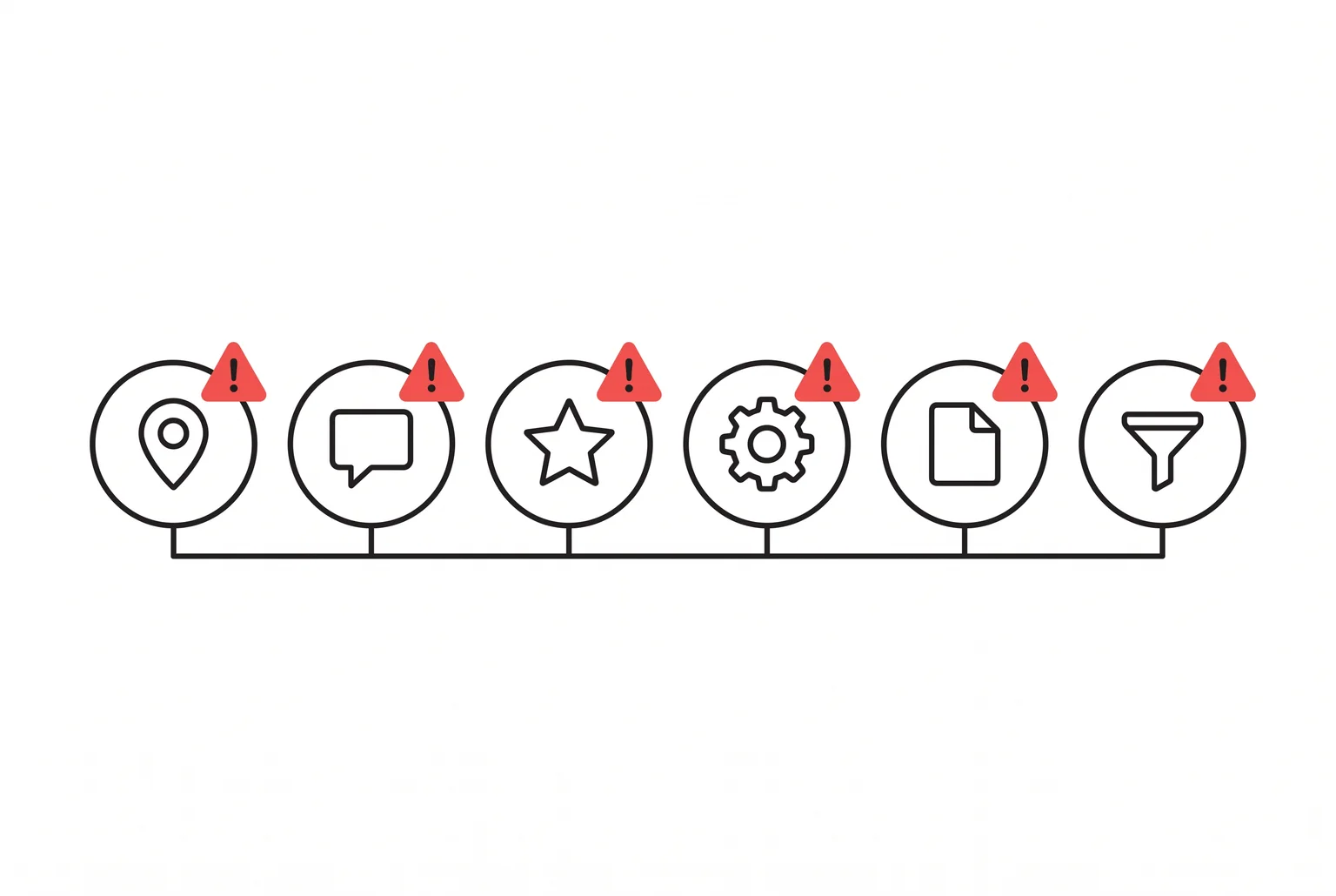
None of these gaps are exotic. They are ordinary web-management failures that happen to sit on top of a market with unusually high stakes.
Fixing each gap without stepping outside the rules
Each of the six leaks maps to a specific fix, and each fix has to work inside the same constraints diagnosed earlier: the CAP Code, UK GDPR, PECR, and the clinical codes your practitioners already answer to.
Local SEO and Google Business Profile gaps get fixed with the boring, unglamorous work of correct categorisation, complete attributes, and a genuine photo library, none of which touches patient data and none of which triggers ASA scrutiny because it makes no efficacy claim at all. It simply describes the practice.
Messaging gaps need condition-specific landing pages that answer the actual question a parent or adult patient is typing into Google, rather than generic copy that could belong to any clinic. This is where ASA's "serious condition" restrictions matter: pages need to describe assessment pathways and what to expect, not promise outcomes or use testimonials that read as treatment claims.
Reviews get fixed with a consistent collection and response system. Testimonials sit inside CAP Code substantiation rules and, once a review references a health outcome, inside the same "serious condition" caution as ad copy. The fix is procedural: collect broadly, respond professionally, and avoid amplifying any single review as a marketing claim.
Technical SEO gaps (slow mobile pages, missing metadata, absent location pages) are fixed with standard technical work that carries no regulatory exposure at all.
Tracking and CRM gaps are the one area where GDPR and PECR bite hardest, because tracking enquiry sources often means tracking identifiable people making health-related contact. The fix is a CRM that separates operational data (which channel produced a booking) from special category data (why someone is booking), with consent captured at the point of contact rather than assumed.
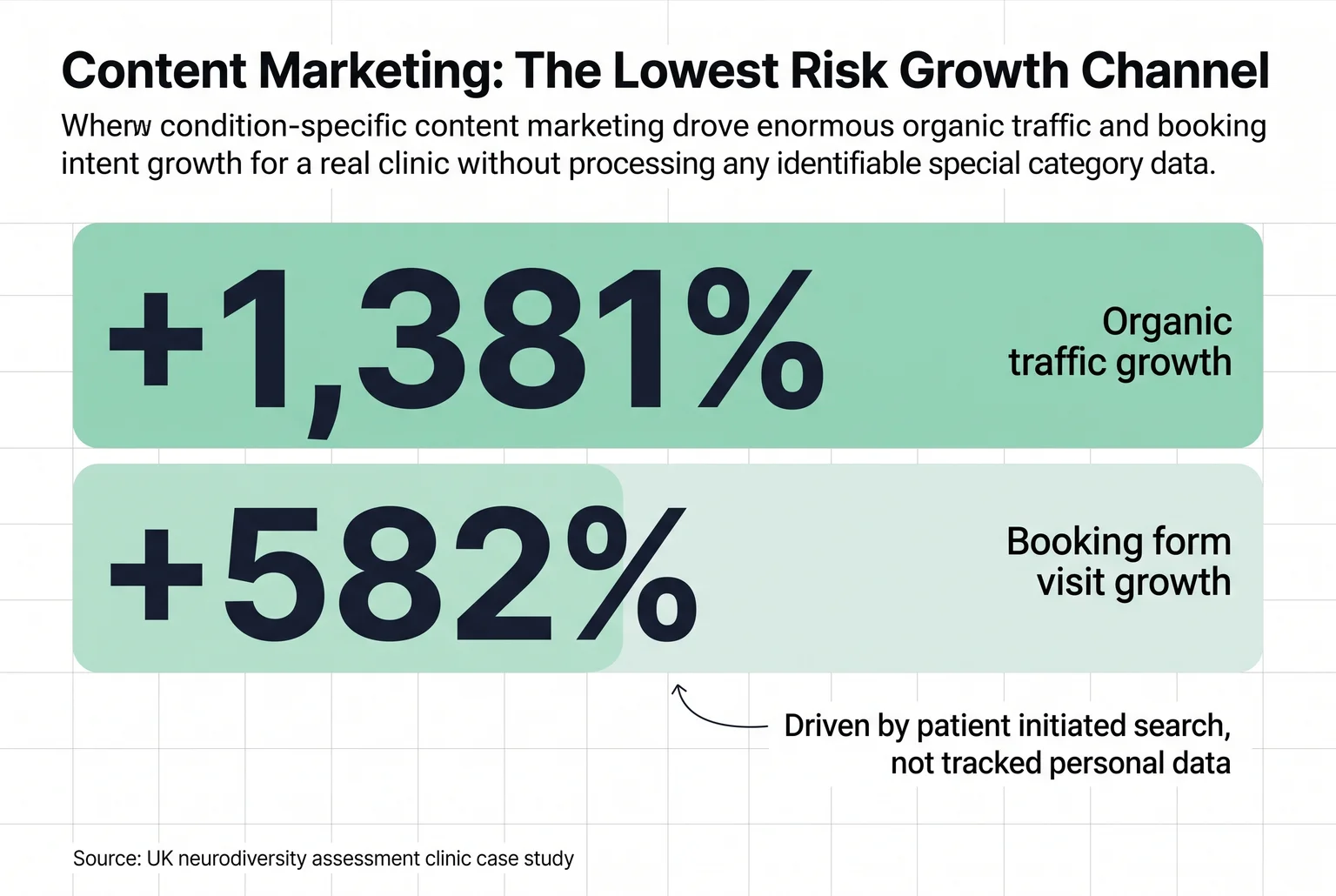
That leaves content, and it deserves separate treatment because it is the single lowest-risk, highest-leverage channel available to a regulated clinic. Condition-specific patient education, symptom guides, and pathway explainers written or reviewed by named clinicians sit squarely inside what Google calls E-E-A-T for topics that affect health and wellbeing, and none of it requires processing identifiable patient data. That is the direct link back to the GDPR section: a clinic can grow through search without ever touching the special-category-data problem, because the reader is anonymous until they choose to enquire. A clinic in Oxfordshire offering private ADHD and autism assessment applied this approach and reported organic traffic growth of 1,381% and booking-form visits up 582%, according to a published case study from Healthcare SEO. That is a single clinic's result, not a market average, but it illustrates the mechanism: authoritative content answers the questions patients are already searching, and Google rewards named, sourced, clinically-reviewed pages over templated marketing copy.
So who is actually reading these pages, and does the same fix work for all of them?
Two readers, two very different search journeys
The content strategy above only works if it answers the right question for the right person, and a private ADHD clinic's two biggest audiences are asking different questions entirely.
Adult women often arrive having already suspected ADHD for some time, sometimes after recognising themselves in social-media content, before starting to search for formal assessment routes. A UK interview study of eight women aged 28 to 53 found a recurring pattern: childhood difficulties, an earlier misdiagnosis or a diagnosis overshadowed by another condition, then years later a period of self-advocacy that leads to seeking assessment as an adult. The same research describes the diagnosis process as often empowering but bittersweet, complicated by previous difficult experiences with services, internalised ableism and stigma. That history matters for messaging. A landing page that opens with a symptom checklist and a booking button skips past everything this reader has already been through. Content that acknowledges late diagnosis, masking and previous dismissal by services, before it gets to pathway and pricing, is doing the actual work of building trust, not just filling space above the fold.

Parents of children waiting for assessment are moving through a different logic entirely, driven by NHS wait times and their effect on schooling and daily life rather than self-recognition. A UK Parliament engagement exercise found that 63% of respondents waiting for an assessment, for themselves or their child, had considered paying privately to be seen faster. Local reporting shows the same pattern repeatedly: parents describing multi-year waits who eventually pay privately, including one mother told to expect a four to five year NHS wait who paid around £3,000 for her daughter's assessment, according to a Netmums feature. These readers search on cost, timing and pathway, not on symptom validation. They need a page that states, plainly, how long an initial appointment takes to arrange, what an assessment costs, and what happens after diagnosis, because that is the decision they are actually trying to make.
Both personas need the same underlying trust signals, named clinicians, clear pathway information, transparent pricing. But the entry point differs: one group needs content that treats misinformation and stigma seriously before it sells a service, the other needs a fast, honest answer to a logistical question they've often been sitting on for months.
What comparable clinics have measured, and why none of it is ADHD-specific
None of the figures below come from ADHD clinics. They come from multi-specialty healthcare groups, aesthetics clinics, and a therapy practice, and the correct way to read them is as transferable benchmarks for what specialist marketing produces in a regulated clinical setting, not a promise of identical numbers for a diagnostic service.
CBR Clinics, a multi-specialty healthcare group, spent months losing leads under a previous agency because of technical website faults. After an integrated SEO, PPC and CRO programme with Klatch, the clinic hit its daily new-patient targets within three months, generating 97 new patient leads and over £30,000 in new business revenue in March 2025 alone. The work itself was unglamorous: rebuilding the site with optimised service, location, and "what we treat" pages.
A separate multi-specialty clinic group ran a nine-month SEO engagement that took monthly bookings from 320 to 1,216, a 3.8-times increase. Organic sessions rose from 12.4K to 42.8K per month, ranking keywords from 780 to 4,120, and keywords placing in the top 10 from 94 to 738. The interventions were condition and treatment pages, enhanced clinician profiles with structured data, multi-location local SEO, Google Business Profile work, and review generation, the same categories of fix set out earlier in this piece for ADHD clinics specifically.
Outside multi-specialty groups, a UK therapist practice became fully booked within four months using a screening quiz, digital PR, and local directory optimisation, cutting £3,200 a month from its paid-ad spend, according to the GDPR Impact On ADHD Clinic Marketing In The UK document. That last figure matters because it shows organic and content-led work displacing paid acquisition, not just adding to it.
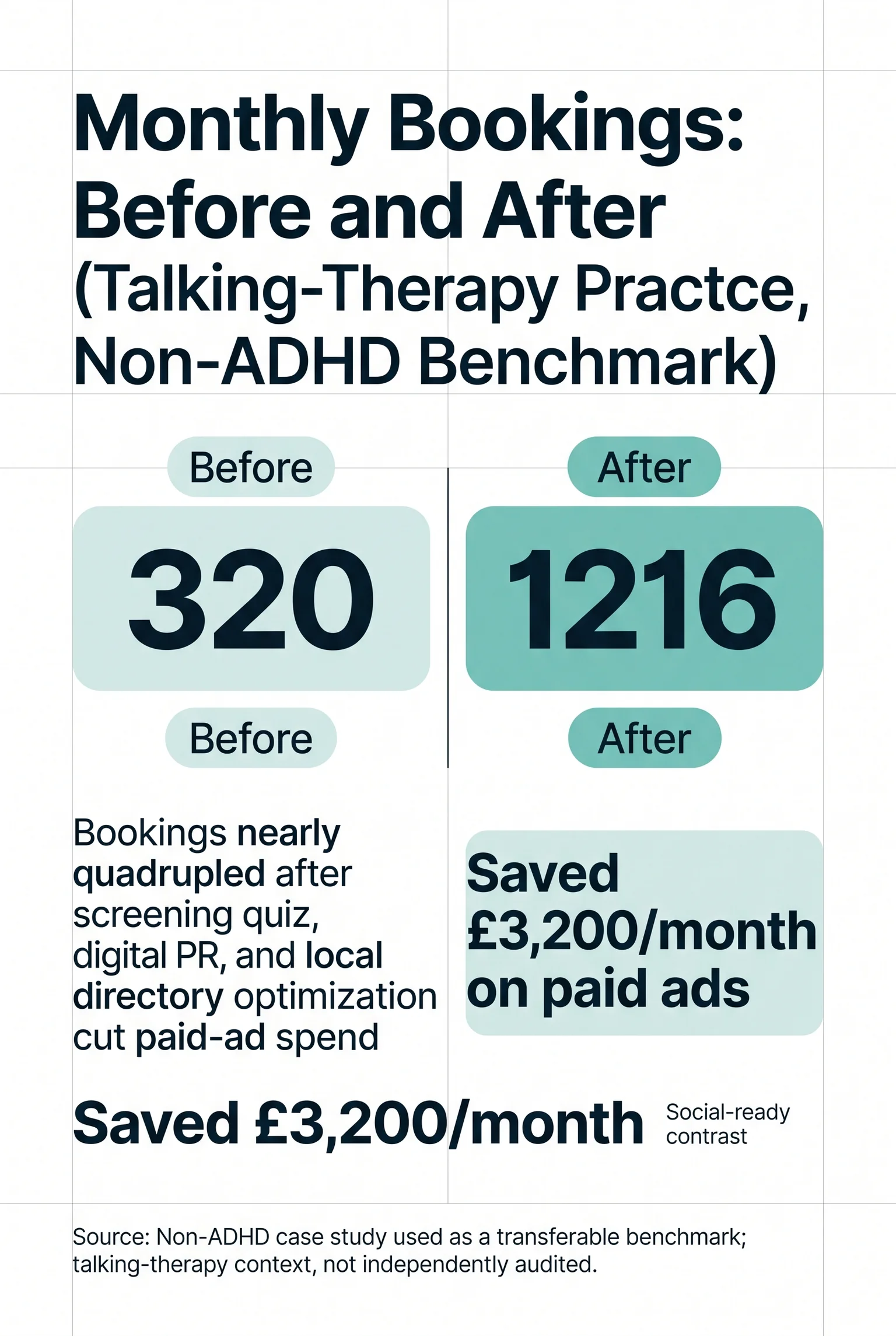
These are agency-reported figures, not independently audited results, and they come from cosmetic, multi-specialty, and talking-therapy contexts where advertising rules and patient sensitivities differ from ADHD assessment. Treat them as evidence that the mechanics work in clinical settings generally, not as a forecast for any specific ADHD clinic.
Where this is heading, and what to do about it now
The NHS ADHD Taskforce's final report, published on 6 November 2025, built on interim proposals from June: standardised data, transparent time-to-treatment reporting, and a minimum data set for independent assessments. That last point matters directly for private clinics. If regulators move toward a common quality framework for independent providers, clinics with clean audit trails and consistent clinical protocols will clear that bar easily. Clinics relying on informal processes and thin documentation will not.
The direction of travel favours digitised triage, remote assessment, and objective tools such as QbTest, alongside a shift from diagnosis-led gatekeeping toward needs-led support while people wait. For clinics, this means opportunity in adjacent services: coaching, psychoeducation, and structured triage, not just diagnosis appointments.
None of this closes the gap between demand and growth on its own. Clinics still have to be found, trusted, and chosen. That's the operational work this piece has been diagnosing throughout.
For clinic operators wanting a starting checklist, in order:
- Run a Data Protection Impact Assessment before launching any marketing channel that touches special category health data, including quiz funnels and ad retargeting.
- Separate data into three tiers: clinical records, marketing-consented contacts, and anonymised analytics, so a breach or audit in one tier doesn't compromise the others.
- Build a claims register for every outcome or diagnostic statement in your marketing, with clinical sign-off, held as documentary evidence in line with ASA substantiation requirements.
- Fix the technical and local SEO basics first: Google Business Profile, condition-specific pages, structured clinician data. Low compliance risk, high return.
- Display your CQC rating correctly under Regulation 20A wherever it's legally required, and nowhere it isn't.
- Set up granular consent capture with periodic refresh and a working suppression list, rather than a single blanket sign-up box.
- Invest in authoritative, patient-education content as the primary growth channel. It's the one lever that gets stronger, not weaker, under GDPR and ASA scrutiny.
The clinics that grow from here won't necessarily have better clinicians than the ones stuck flat. They'll have fixed the visibility problem instead of mistaking it for a clinical one.
Sources
- How to Get More Patients from Google in the UK: A Healthcare SEO Guide | Futurise Studio Blog — Futurise Studio
- SEO Mistakes That Keep Patients from Finding Your Healthcare Practice — Southern Digital Consulting
- How We Increased Organic Traffic by 350% for a Multi-Specialty Clinic in 12 Months | Socialsect | Socialsect — Socialsect
- CBR Clinics Digital Marketing Case Study | Klatch — Klatch
- 3.8x Patient Bookings For a Multi-Specialty Clinic — Case Study | 4Core Digital — 4Core Digital
- GDPR Impact On ADHD Clinic Marketing In The UK — provided document