

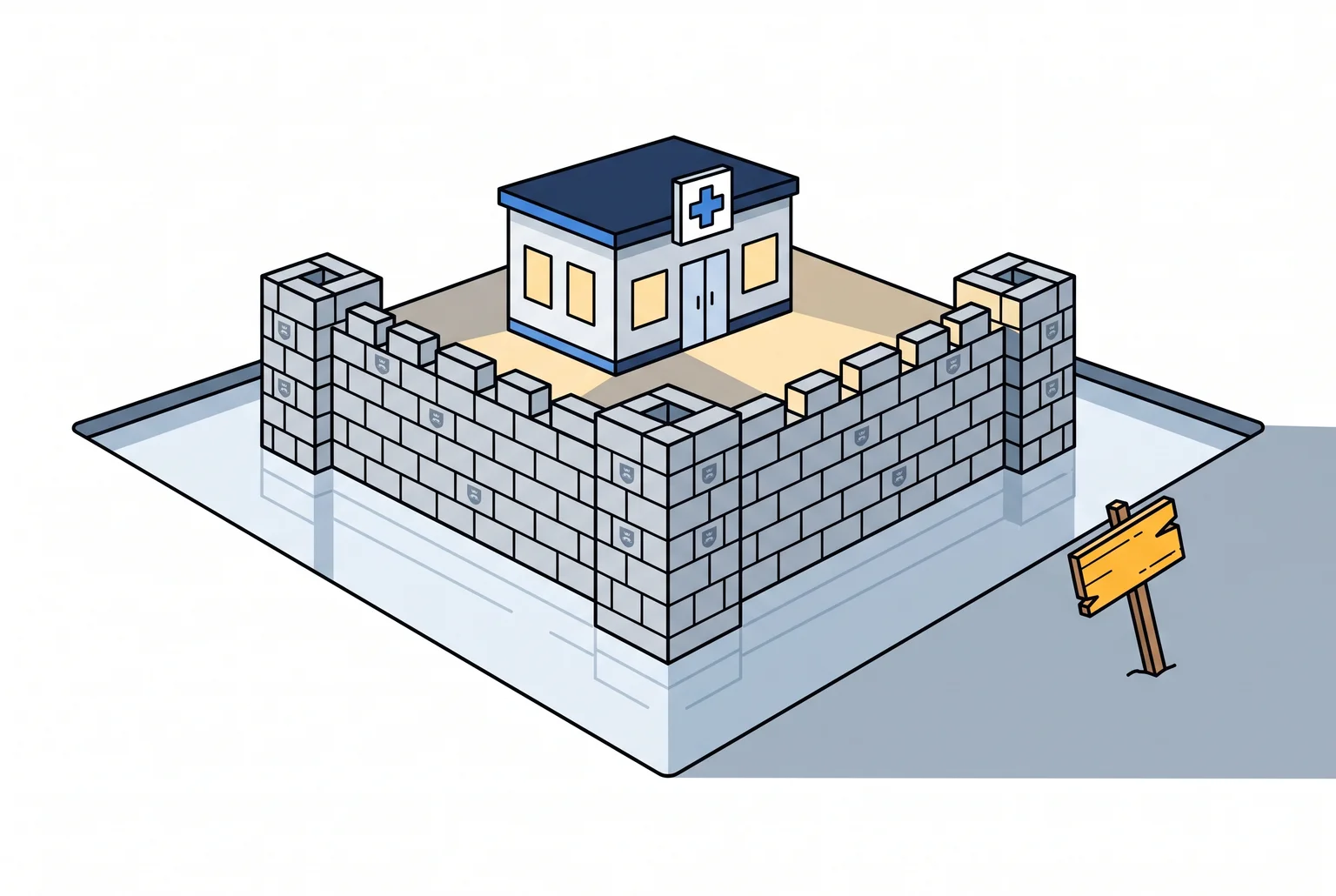
Why the cautious clinic loses the enquiry
Regulation can feel like a handbrake on a private practice.
You can spend an evening checking whether a patient comment can be used on the website, whether consent covers the use you have in mind, and whether the wording of a treatment claim goes further than the evidence. A practice two streets away may simply put a five-star screenshot on Instagram and get on with it. Sometimes they will get the enquiry.
I understand why that irritates careful practitioners. For a while, the less careful business can look as though it has found a commercial advantage.
Take two clinics on the same road. I am not describing real businesses here; I want to isolate the mechanism. One is HCPC-registered. Its case-study language is cautious and it will not publish an outcome it cannot support. The other clinic has a page full of glowing reviews. Some were incentivised and the incentive is not disclosed.
For a period, the second clinic may win more local enquiries. It is making stronger claims and presenting more social proof. A prospective patient does not necessarily know which parts would survive scrutiny.
That matters more now than it did a few years ago. Fake reviews and concealed incentives became banned practices under the Digital Markets, Competition and Consumers Act 2024 on 6 April 2025. The CMA also gained the power to impose substantial penalties directly. For a business that has treated review manipulation as a harmless shortcut, the commercial calculation has changed.
I would go further. The careful clinic has been treating one of its assets as though it were merely a restriction.
If its claims can be evidenced, its credentials checked and its patient permissions traced, it has something useful to build on. The competitor can copy the website layout tomorrow. It can copy an offer, a page structure or a keyword. It cannot retrospectively create a sound consent trail or make an exaggerated claim true.
That is the starting point for the Homeorhesis I.M.P.A.C.T. argument about compliance. I am not suggesting that regulation automatically produces growth. It plainly does not. I am saying that, in a regulated practice, marketing which cannot survive professional or legal scrutiny is a weak foundation for growth however well it performs in the short term.
Which rulebook actually applies to you
This is one of those questions that sounds easier than it is.
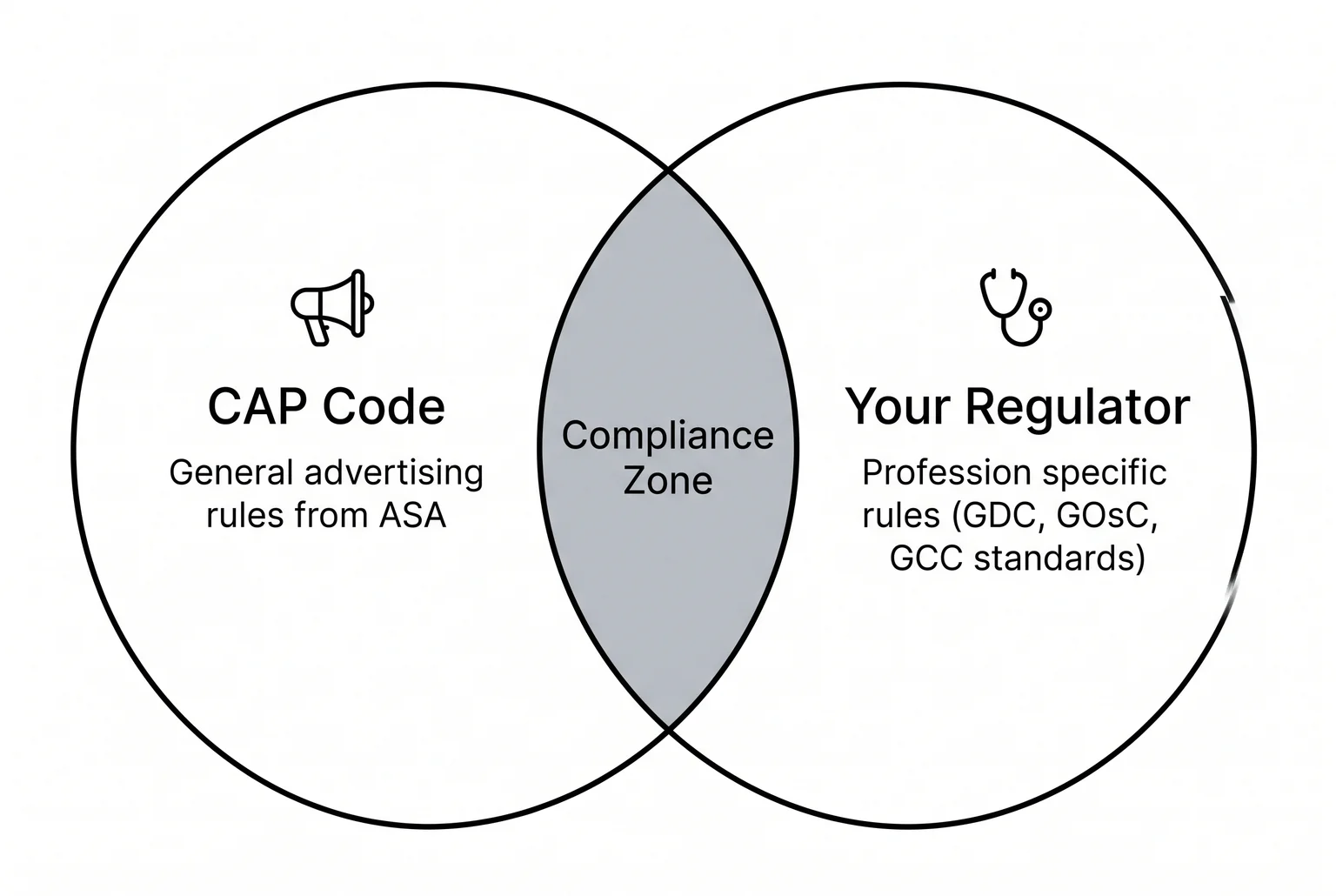
Ask a practice owner who governs their marketing and they will usually name their professional regulator. That answer may be correct, but it is incomplete. Marketing by a regulated practice normally sits inside a general advertising framework as well as the rules and standards attached to the profession.
The CAP Code is part of that first layer. It covers non-broadcast marketing communications including website copy, social posts, paid advertising and printed material. Health-related claims bring Section 12 into view; food and supplement claims have their own requirements under Section 15.
Then there is the professional layer. The detail changes by profession. Dental practices, for example, have GDC requirements around publicity, including clarity about whether treatment is NHS, private or mixed. Osteopaths have their own practice standards alongside CAP and BCAP requirements. Chiropractors are expected to keep advertising legal, decent, honest and truthful, and the GCC has published learning from fitness-to-practise cases involving unsupported advertising claims.
HCPC registrants are slightly different because there is no separate HCPC advertising code sitting neatly on a page with that title. I would not read that as an absence of obligation. The standards of conduct, performance and ethics still apply to communication, social media and professional behaviour. The practical question remains the same: could you defend what the practice has published if somebody with authority asked for the evidence behind it?
There may be other rulebooks as well. Payment plans can bring FCA consumer-credit requirements into the picture. CQC registration is often misunderstood because it depends on whether the service being delivered is a regulated activity. I would check the practice’s actual position rather than infer it from the type of clinic.
This sounds like compliance detail, but it changes marketing decisions. If nobody has mapped which rules apply, the practice has no reliable way of deciding what can be claimed, what evidence needs to be retained, or who should approve material before publication.
Put A Value on the Gap
The next question is commercial: what is a weak system actually costing?
Suppose a clinical psychologist charges £120 an hour and has capacity for twenty sessions a week. At full utilisation the theoretical annual fee income is close to £128,000. I would not use that as a forecast; real diaries contain cancellations, holidays and empty slots. It is useful here because it gives us a scale.
One unused appointment a week is worth a little over £6,000 across a year at that fee. You will not find it recorded as a loss in the accounts. The money never arrived, so there is nothing to record.
The more useful question is why the appointment stayed empty.
Sometimes the answer is demand. Sometimes it is poor local visibility. But I have learned to be wary of jumping straight to “we need more leads”. An enquiry may already have arrived and gone unanswered for half a day. The prospective patient may have found the website but remained uncertain about the practitioner’s credentials, fees or process. They may simply have contacted three practices and booked with the first one that made the next step easy.
AI-assisted search adds another route through which that judgement can now be formed. A 2025 US survey reported that around a quarter of patients said AI tools had directly influenced their choice of provider. I have not found equivalent UK evidence of the same quality, so I would not turn the American figure into a British claim. I would, however, pay attention to the direction of travel.
Systems that assemble answers need material they can verify and cite. A registered credential, a clearly described service, a supported claim and a consistent body of information are useful inputs. Inflated outcomes and recycled testimonials are much less useful once somebody, human or machine, starts checking them.
For me, that is where the supposed conflict between compliance and marketing begins to look wrong. Compliance will not rescue poor positioning or a slow enquiry process. But it can give the practice a body of evidence that deserves to be visible. The marketing job is to make that evidence easy to find and easy to understand without turning it into a promise the clinical work cannot guarantee.
The claim and the consulting room
Before-and-after imagery is where I see careful practices come unstuck most often, and it is usually a delegation problem. A template gets adapted, a logo dropped into it, and the caption is written by somebody who has never had reason to read Section 12.
CAP guidance on before-and-after photographs asks for documentary evidence that the images are genuine and that the patient consented to their use. It also warns that a comparison can mislead without any words attached to it. Add a phrase such as “guaranteed pain relief in three sessions” and there is a second problem, because claims and images must not exaggerate an effect or present an unusual result as the ordinary one. Dental practices carry the additional GDC requirement that promotional material is accurate and supported by fact.
The underlying rule is not complicated. A practice should not publish a promise that its consulting room can only sometimes keep. Why? Because the published claim becomes evidence on the day a patient’s outcome falls short of it, and by then the patient has the screenshot.
So the approval question I would put in front of anything before it goes live is a simple one: could you show a regulator that claim, that image and that consent trail tomorrow morning, with the paperwork behind it?

Reviews, and the failure practices rarely see coming
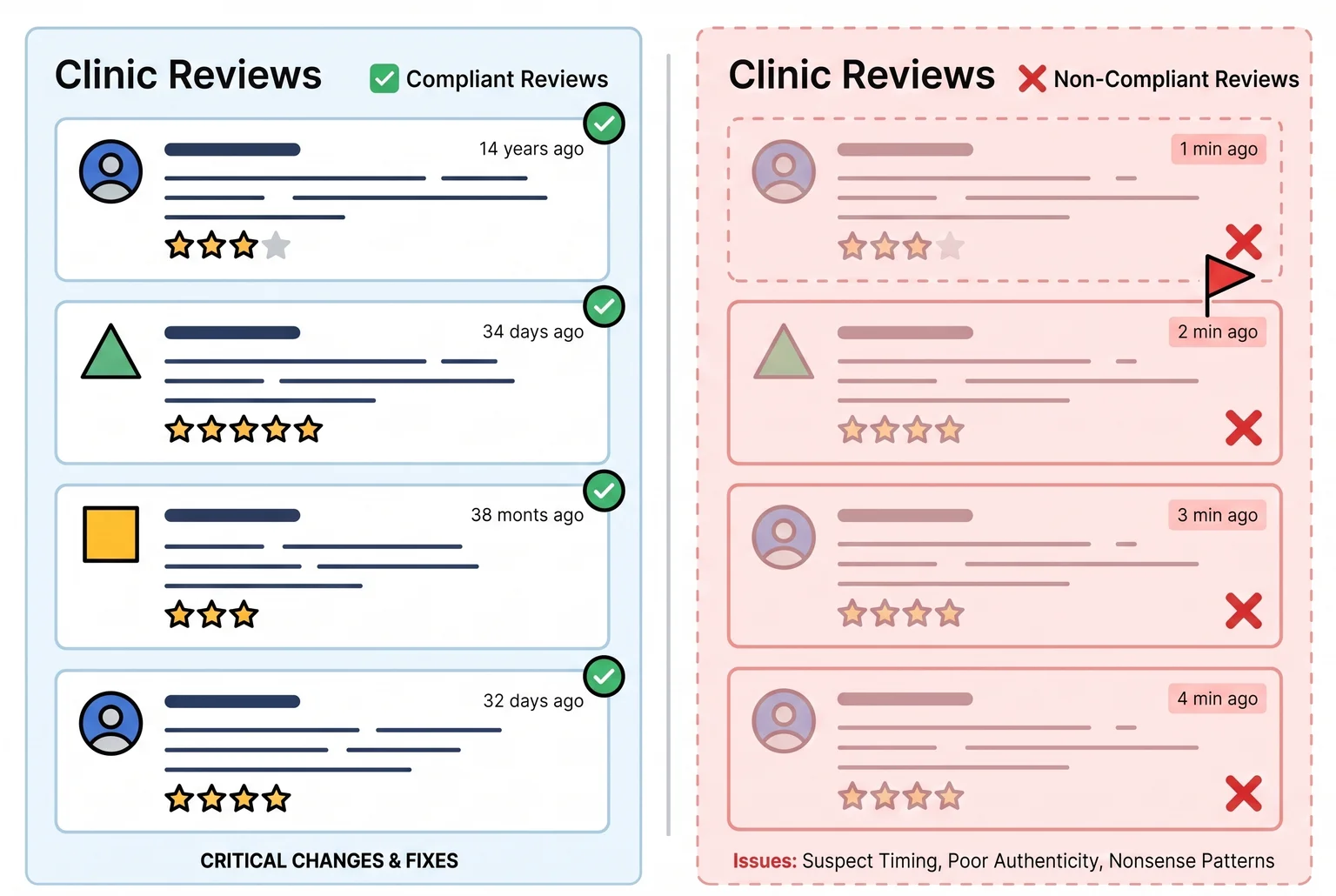
Most owners now understand that buying reviews is unlawful. The commoner failure is smaller and more awkward: reviews written by people close to the business and published without any disclosure. A partner of a staff member. A supplier. Somebody who genuinely was a patient but also happens to be a friend.
CMA guidance places the obligation on any trader who publishes reviews, not only on the large platforms, and the steps required are reasonable and proportionate ones to prevent and remove fake reviews, concealed incentivised reviews and misleading review information. Suppressing negative feedback or presenting an aggregate rating that misleads falls inside the same guidance.
I would write the policy down. Who is asked, at what point in the care pathway, what happens when the reviewer has a connection to the practice, and where a disputed review gets logged. It takes an hour, and it is the document you will want in front of you if anybody ever asks.
The enquiry form is a data collection point
This one gets missed because it does not look like a marketing decision.
The moment somebody types a symptom or a diagnosis into a box on your website, you are processing special category personal data. Two separate foundations are needed: an Article 6 lawful basis and an Article 9 condition. Consent is only one of ten conditions, and for a genuine care enquiry the contract or the health and social care conditions will often fit the facts better. That turns on the specifics, and ICO guidance is the place to settle it.
The part practices trip over is reuse. An enquiry made about treatment is not permission to add somebody to a mailing list. Separate the two workflows at the point of capture, record which basis and condition apply to each, and set a retention period you could defend. Keeping everything indefinitely is a decision, even when nobody made it deliberately.

Showing the process without promising the outcome
A private adult ADHD assessment in the UK runs somewhere between roughly £700 and £1,500. One 2024 review across several hundred clinics put the average in the region of £1,267, and Psychiatry-UK publishes its own adult fee at £950. Those are market figures rather than a tariff, and I would not hold any individual practice to them. The spread is the useful part.
Somebody committing that much money wants to know what they are buying before they commit it, and the outcome is the one thing you cannot promise them. You can describe the process in as much detail as you like. Most practices under-do this badly. Publish the intake form. Show the structure of an anonymised report. Say how long the assessment takes, what happens between assessment and feedback session, and who will be in the room.
None of that touches clinical outcome, and it answers the questions people are sitting on when they close the tab without enquiring.

Consent, and a referral list worth having
HCPC guidance on consent and confidentiality is specific. Information may be disclosed where the person has consented, where the law allows it, where it serves their best interests, or where it serves the public interest. Permission comes before anything a patient has said appears in your marketing.
A list built that way looks unremarkable from the outside. Named consent, a working unsubscribe, referring GPs and allied clinicians who asked to be on it, and content written to be useful to the people on it. It is slower to build than a bought list, and it does not evaporate the week a regulator takes an interest in somebody’s review profile.

Being found, by people and by systems
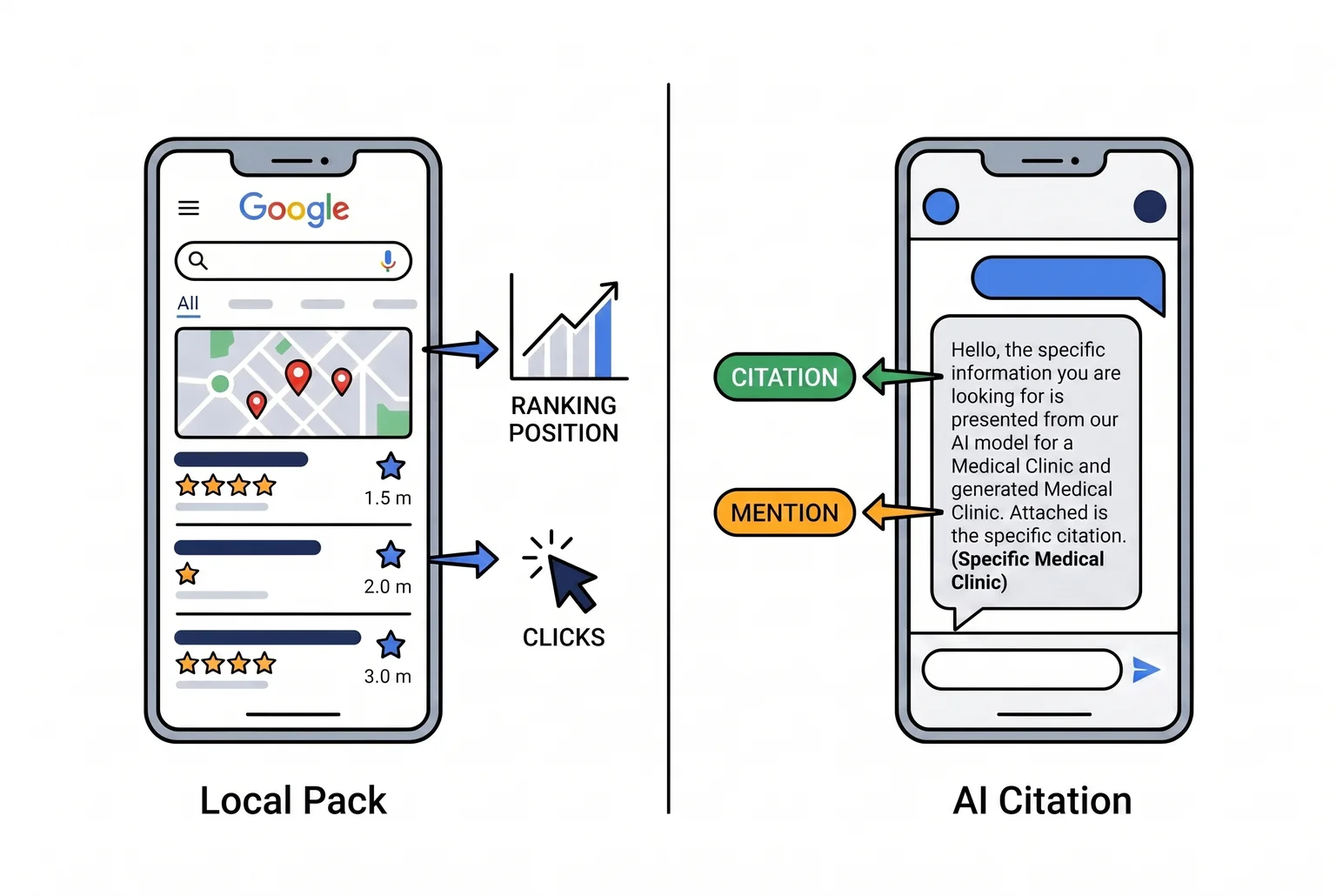
Distribution still has to happen, and the familiar half of it has not changed much. Google Business Profile signals, location pages, consistent name, address and telephone details, a steady flow of genuine reviews, measured by local pack position, click-through and calls.
The newer half is that some prospective patients will never see a list of links at all. AI tools assemble an answer, and being cited inside that answer is a visibility outcome of its own. I would treat most confident advice about generative engine optimisation cautiously, because it is an emerging practice with no audited data behind it. The habits it points to are sensible in any case, and they happen to be the habits of a well-documented practice: direct question-and-answer sections, clean schema markup, and content written in citable chunks.
Either route sends somebody to a page that evidences the practice or does not. That is the part I would fix first.
Working through it
What follows is a composite, drawn from patterns across several clinics. It is not one client and it is not an audited case.
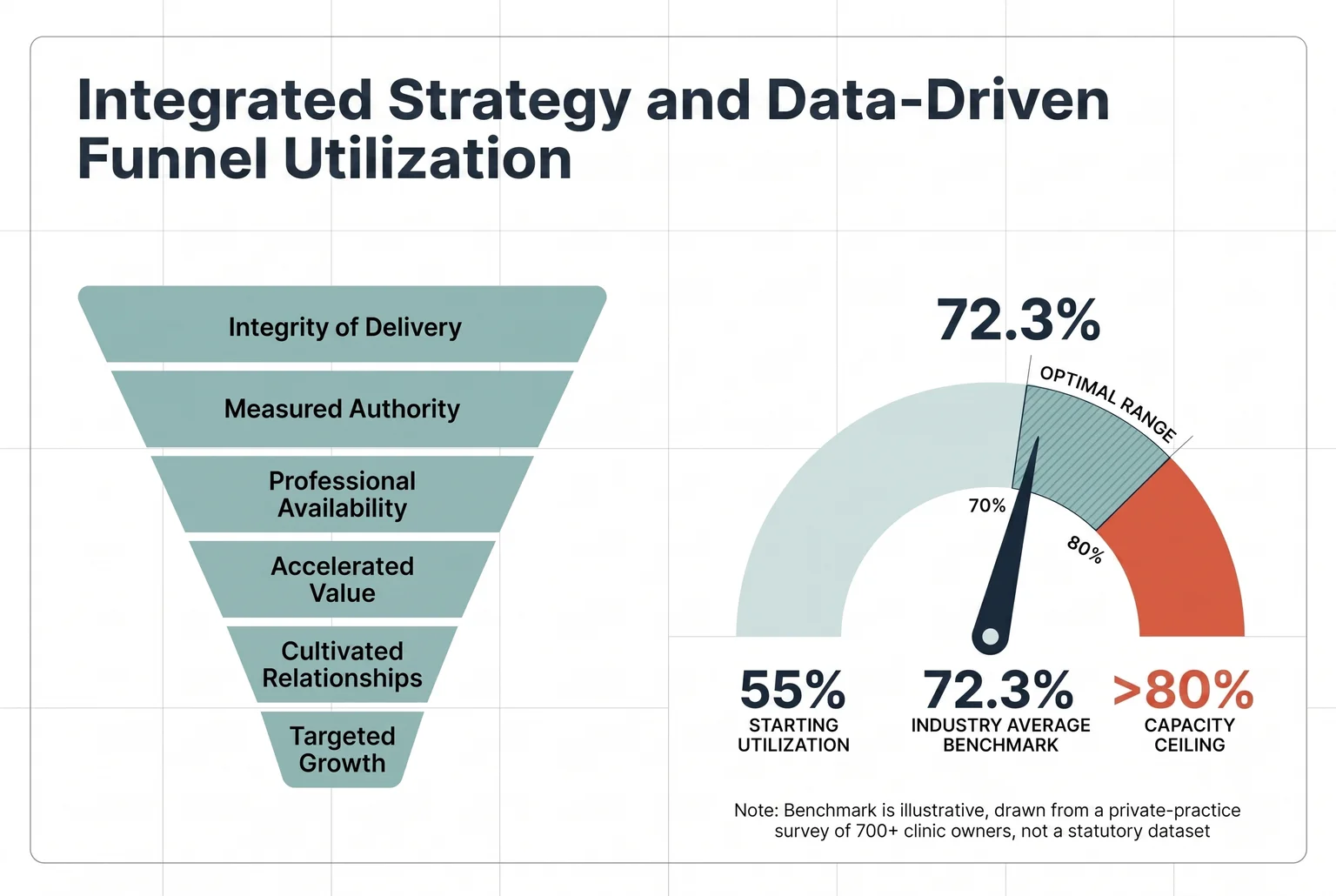
A physiotherapy practice leads with a guaranteed pain relief claim and a wall of unverified five-star reviews. Enquiries are sporadic. Associate diaries sit around 55% full, against the 70 to 80% band that one private practice survey treats as healthy operating capacity.
The obvious intervention is more enquiries. I would not start there. The claim comes down first, because everything built on top of it is exposed while it stands, and the review wall is the other half of the same exposure. That is unglamorous work and it produces no immediate increase in anything.
The enquiry route comes next. A lawful basis worked out, a response time somebody is accountable for, and the assessment breakdown published so a prospective patient can answer their own questions at eleven at night. Referral relationships and local search follow, in whatever order the practice can actually sustain.
Utilisation moves towards the 70 to 80% band over several months. It stays under the 80% ceiling the same survey flags as a burnout risk, which matters if the improvement is meant to last beyond the first quarter.
Where I would start
Most practices have a version of that 55% diary somewhere in the books, and finding it does not require hiring anybody.
At the very least, work out which rules actually apply to your marketing, who approves material before it is published, and what evidence you hold for the claims already sitting on your website. If a second pair of eyes would help, I look at where a practice stands against the Homeorhesis I.M.P.A.C.T. systems and tell you what I find.
Regulator and source list for verification
- Advertising Standards Authority / CAP — CAP Code Section 12: medicines, medical devices, treatments and health; Section 15: food and health claims; guidance on before-and-after imagery.
- General Dental Council — Guidance on advertising, effective 30 September 2013.
- General Osteopathic Council — Osteopathic Practice Standards, effective 1 September 2019; joint advertising message issued with the ASA and CAP.
- General Chiropractic Council — The Code of Professional Practice, effective 1 January 2026; fitness-to-practise learning on unsubstantiated advertising claims.
- Health and Care Professions Council — Standards of conduct, performance and ethics, effective 1 September 2024; guidance on consent and confidentiality.
- Care Quality Commission — Scope of registration, page last updated 29 January 2025.
- Medicines and Healthcare products Regulatory Agency — Blue Guide: advertising and promoting medicines, updated November 2020.
- Financial Conduct Authority — Consumer Credit sourcebook (CONC), in force since 1 April 2014.
- Competition and Markets Authority — Fake reviews (CMA208), enforced under the Digital Markets, Competition and Consumers Act 2024, in force 6 April 2025.
- Information Commissioner’s Office — Special category data; lawful bases and conditions for health information; storage limitation.
- myTribe Insurance (2025) and Going Private UK (2026) — private ADHD assessment and private practice fee ranges, cited as illustrative market figures.
- MediaPost (2025) and Medical Economics (2025) — US patient survey data on AI tools and provider choice, cited as non-UK evidence.
- HMDG (2026) — private practice utilisation benchmarks, cited as a single-survey figure rather than an audited standard.